19 Minimalist Japanese Decluttering Tips That Actually Work
This site contains affiliate links. We may earn a small commission, at no extra cost to you. Article may contain some images for illustrative purposes only .
A cluttered home is never really just about the stuff, and I think somewhere deep down you already know that, which is why buying a new set of storage bins fixes things for approximately four days before the chaos quietly returns as if nothing happened.
Japan figured out that the stuff is never actually the problem; it’s your relationship with the stuff, and that’s a fundamentally different starting point that leads to fundamentally different results.
What follows isn’t a list of hacks dressed up in Japanese packaging; these 19 tips are drawn directly from KonMari, Danshari, Ma, and 5S, and the reason they work when everything else hasn’t is that they change how you see your home, not just how it looks on a Saturday afternoon.
1. Start by Visualizing Your Ideal Lifestyle

Principle: KonMari’s foundational step. You can’t decide what to keep unless you know how you want to live.
Before you lay a finger on a single sock, close your eyes in each room. Picture the morning light on a clear floor. The feeling of opening a drawer and seeing only beloved things. The calm of an empty kitchen counter.
Write down the words that capture this vision. Are we visualising “peaceful mornings,” “easy breath,” “space to stretch?” This vision becomes your compass. Every item you touch will be measured against it.
2. Tidy by Category, Not by Room

Principle: The KonMari Method’s most revolutionary rule. Tidying by location only moves clutter around. Tidying by category forces you to see the full truth.
Gather every piece of clothing from every closet, hamper, and coat hook. Pile it all on the bed. I know, I know it’s overwhelming, but just trust me.
The sheer mountain is a powerful reality check. Then sort in the correct KonMari order: clothes, books, papers, komono (miscellany), and finally sentimental items. You build decision-making muscle on the easy stuff first and move to the difficult ones.
3. Hold Each Item and Ask: “Does This Spark Joy?”
Principle: The famous tokimeki test. You choose what to keep, not what to discard.
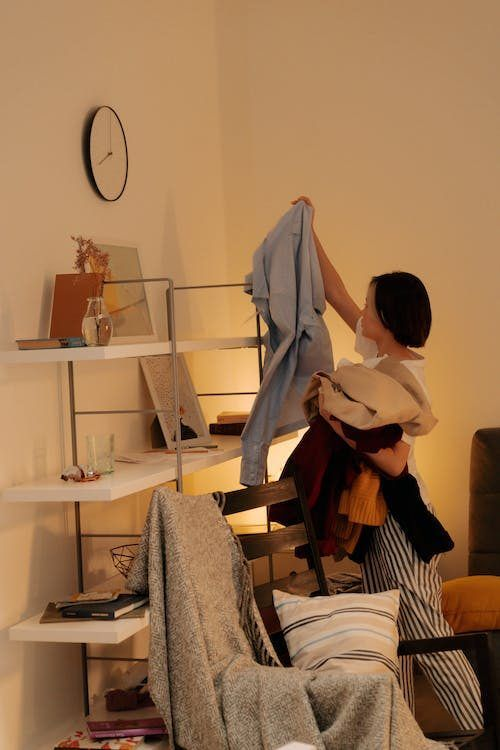
Pick up each object with both hands. Pay attention to your body’s immediate, honest reaction. Did you gasp because you only just found that you own this item? Does touching this item make you feel light and happy, or heavy with obligation?
If the answer isn’t a clear, joyful “yes,” thank it for its service and let it go. This bypasses the endless mental loops of “it was expensive” or “I might need it someday.” I know it’s difficult, as a serial shopper, trust me when I say this, YOU NEED THIS!
4. Practice Danshari: Refuse, Dispose, Separate
Principle: Hideko Yamashita’s holistic decluttering philosophy. Dan means to stop unnecessary items from entering your home. Sha means to dispose of excess. Ri means separate from the emotional attachment that traps you.
Start at the front door. Refuse the free pen, the impulse sale item, and the hotel toiletry bottle. Then fill one bag with obvious rubbish, broken things, and expired products.
For the items you struggle to release, say aloud: “I am not my possessions. My worth is not stored in this object.” This three-part system makes your threshold the first and strongest line of defence.
5. Don’t Buy Storage Solutions Before You Discard

Principle: A core KonMari warning. Storage containers conceal clutter; they don’t resolve it.
It’s tempting to buy beautiful baskets and boxes first, imagining a Pinterest-perfect, tidy space. Resist. Do the full category purge.
Only when you know exactly what remains and where it will live do you acquire the right container. You’ll almost certainly need far fewer than you imagine.


6. Thank Every Item You Let Go
Principle: Mottainai (respect for the value of things) meets shūketsu (closure). This practice is deeply rooted in Shinto-influenced gratitude.
As you place a worn-out shirt or a gift you never used into the donation bag, pause for a second. Say, aloud or in your heart, “Thank you for the joy you once gave me” or “Thank you for teaching me that this colour doesn’t suit me.”
Even broken objects receive gratitude. This small ritual dissolves the guilt that makes discarding painful. It transforms letting go into a respectful, positive act.
7. Apply the 5S Method for Ruthless Clarity
Principle: This one’s Toyota’s legendary efficiency framework. It has Seiri (Sort), Seiton (Set in Order), Seiso (Shine), Seiketsu (Standardize), and Shitsuke (Sustain).
Walk into one small zone, maybe a single drawer, a kitchen counter.
Step 1: Remove absolutely everything that isn’t essential.
Step 2: Assign a fixed home to each remaining item based on how you move.
Step 3: Clean the empty space until it gleams.
Steps 4 and 5: Make a tiny daily habit card to keep it that way. The 5S cycle turns decluttering from a crisis into a sustainable skill.
8. Create a “Power Spot” of Emptiness (Ma)

Principle: Ma is meaningful negative space. Emptiness is not a void; it’s a breathing pause that makes everything around it more beautiful.
Choose one horizontal surface: the coffee table, your desk, or the kitchen counter. Remove everything from it. Leave it intentionally and completely bare for one week. Notice the relief that comes with this act.
The calm becomes addictive. Soon, you’ll find yourself protecting Ma on other surfaces, removing items without being asked.
9. Fold Clothes to Stand Upright (The KonMari Vertical Fold)

Principle: Drawers should work like filing cabinets, not laundry piles.
Fold each garment into a smooth, compact rectangle that can stand on its own edge. Arrange them in rows by colour gradient if that pleases you.
When you open the drawer, you see every t-shirt, every pair of socks, in a single glance. No digging, no forgotten layers at the bottom. With this method, my mornings lost a layer of low-grade stress, and my cortisol levels are grateful for that.
10. Use the Floor-Only-For-Furniture Rule

Principle: In traditional Japanese homes with tatami mats, the floor is a place for sitting, sleeping, and moving freely, not for storage.
Walk through your home with a fresh eye. Remove every pile of magazines, every stray box, every shoe that isn’t in the genkan. Bags go on hooks, books on shelves.
A completely clear floor instantly makes a room feel 40% larger and 100% more serene. It is the ultimate decluttering benchmark if you ask me.
11. Curate Sentimental Items Into a Single, Visible Keepsake

Principle: You are not your past. Honour it without letting it dominate your present living space.
Sentimental items are sorted last, once your decision-making muscle is strong. Gather every letter, photo, and childhood memento. Pick the three that most powerfully evoke the love behind the memory, not the loss.
Frame one, display one, and store one in a beautiful wooden box. Release the rest with gratitude. A curated handful of treasures holds far more emotional weight than a dusty bin in the attic.

12. Embrace the Seasonal Swap (Koromogae)
Principle: Twice a year, Japanese households rotate everything. The clothing, the bedding, and the home decor to match the season.
On or around June 1st and October 1st, wash and store away out-of-season garments in breathable kiri boxes or under-bed drawers. As you handle each piece, you naturally assess it: does it fit? Does it still feel like me?
Items that no longer serve you are thanked and released. This built-in calendar event prevents the silent accumulation of unworn clothes over the years.
13. Perform a Daily 5-Minute Evening Reset (Soji Spirit)
Principle: Soji is a spiritual practice of cleaning. Order is maintained daily, not frantically restored on weekends or on the day your guests visit.
Set a timer for five minutes before bed. Walk through each room with an empty basket. Pick up anything that isn’t in its home and return it. Wipe the kitchen sink dry. Fluff the cushions. In five minutes, you’ve reset the visual peace. You wake up to yesterday’s calm, not yesterday’s mess.
14. Everything Must Have a Single, Fixed Home

Principle: Seiton from 5S, which means set in order. An item without a home is a nomad that becomes clutter.
For every single possession you decide to keep, ask: “Where exactly does this live?” The answer cannot be “the spare room floor” or “somewhere in the hall closet.”
It must be a precise, reachable spot. Scissors live where packages are opened. Keys live on a tray by the door. When the home is obvious and close, putting things back becomes a reflex.
15. Cultivate Wabi-Sabi: Let Go of Perfection
Principle: The beauty of impermanence, imperfection, and the handmade.
Your home will never look like a sterile catalogue, and that is the point. Keep the worn wooden spoon that fits your hand perfectly. Let the chipped ceramic bowl you love stay on the shelf.
Wabi-sabi releases the pressure to create a flawless, empty box. It allows your decluttered space to feel deeply personal and alive, not cold.
16. Treat Decluttering as a Skill, Not a One-Time Project
Principle: Shitsuke, which means Sustain. The final S in 5S. Discipline that becomes second nature through gentle repetition.
Decluttering is not a mountain you climb once and then forget. It’s a muscle. Dedicate fifteen minutes once a month to revisiting a single drawer or shelf. Not a massive purge, maybe some just light, mindful curation.
The habit keeps your relationship with your possessions intentional for life, not just for the brief window after a spring clean.
17. Use the “One In, One Out” Rule Relentlessly
Principle: A direct, practical application of the Danshari container principle. Your home is a fixed vessel with a defined capacity.
When you purchase a new shirt, an old one must be thanked and released immediately. A new book means one leaves for a free library. Your collection improves in quality, not quantity. The volume stays constant, and the threshold remains sacred, and you? Yes, you won’t be going crazy.
18. Limit Yourself to a Fixed Number of Hangers

Principle: A visual, physical manifestation of the fixed-capacity idea. Your wardrobe becomes a strict container.
Put exactly thirty hangers in your closet or whatever number your space can comfortably hold. That is your absolute limit. When all hangers are occupied, a new garment can only enter if an existing one is released. The decision is no longer abstract; you can see the clear boundary.

19. Practice the “One Touch” Rule for Incoming Paper
Principle: Adapted from the Japanese instinct to stop clutter at the genkan (entryway). This is Dan (refusal) in action.
When you bring in the mail, stand at the recycling bin. Open each envelope. Junk mail drops straight into the bin. Bills are photographed, paid, or filed immediately. No “to sort later” pile is ever created.
Paper, touched once, is either dealt with or discarded. Your horizontal surfaces stay beautifully bare, and you will be on top of everything.
The Quiet Gift of These Practices
The most important thing I want you to take away from this is that decluttering done the Japanese way is not a weekend project you complete and then forget about; it’s a gradual shift in how you relate to every single object you allow into your home.
You don’t have to KonMari your entire apartment in one emotional Saturday or throw away everything you own to feel the difference because that’s not what any of these philosophies are actually asking of you.
The calm that comes from a home that only holds things you genuinely need and love is one of those things you cannot fully understand until you feel it, and once you do, you will wonder why you spent so long negotiating with a drawer full of things you don’t even like.