
33 Timeless Nursery Rooms
This site contains affiliate links. We may earn a small commission, at no extra cost to you. Article may contain some images for illustrative purposes only .
The best time to start on a nursery is earlier than you think. Months before the due date, the room is still an empty space with a few open choices, and that is a good place to be. Paint, furniture and layout all take time to pick, order and set up, and they are easier to settle when nothing is rushed. This list gathers 33 nursery rooms made to stay relevant well past the first year. Some are calm and pale, others are bolder, and each one is built on choices that will not feel dated when the crib is swapped for a bed. Browse them now, while the choices are still easy to compare. Save the ones you keep returning to. Start early. Then you can move through the planning with a clear picture of the room you want, one decision at a time, and with room to change your mind.
Floral Wallpaper
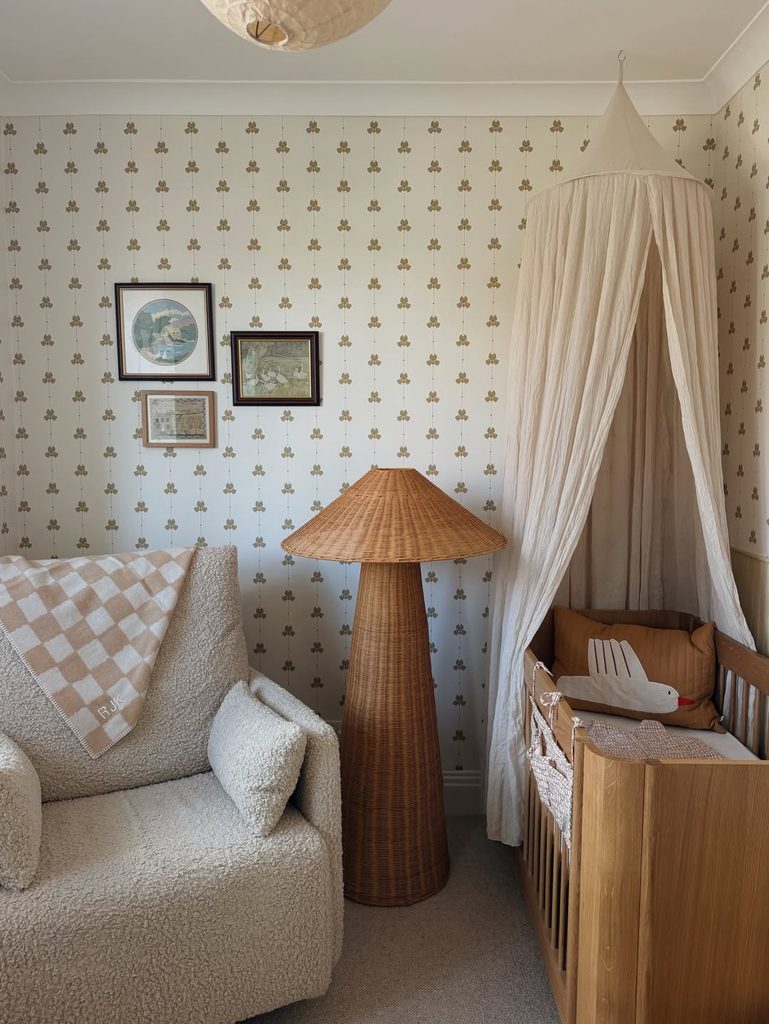
A repeating floral wallpaper gives this nursery its old-fashioned character, while the cream chair and wood crib keep the rest of the room quiet. This approach is for parents who like a clear pattern and want the main furniture in natural, pale materials rather than a theme built around cartoon art or strong color. It also works for a room with enough floor space for a separate chair beside the crib.
If you prefer plain walls, or need every corner for storage and play, this much pattern and a large chair may feel like too much.
Low Contrast Plaid Walls
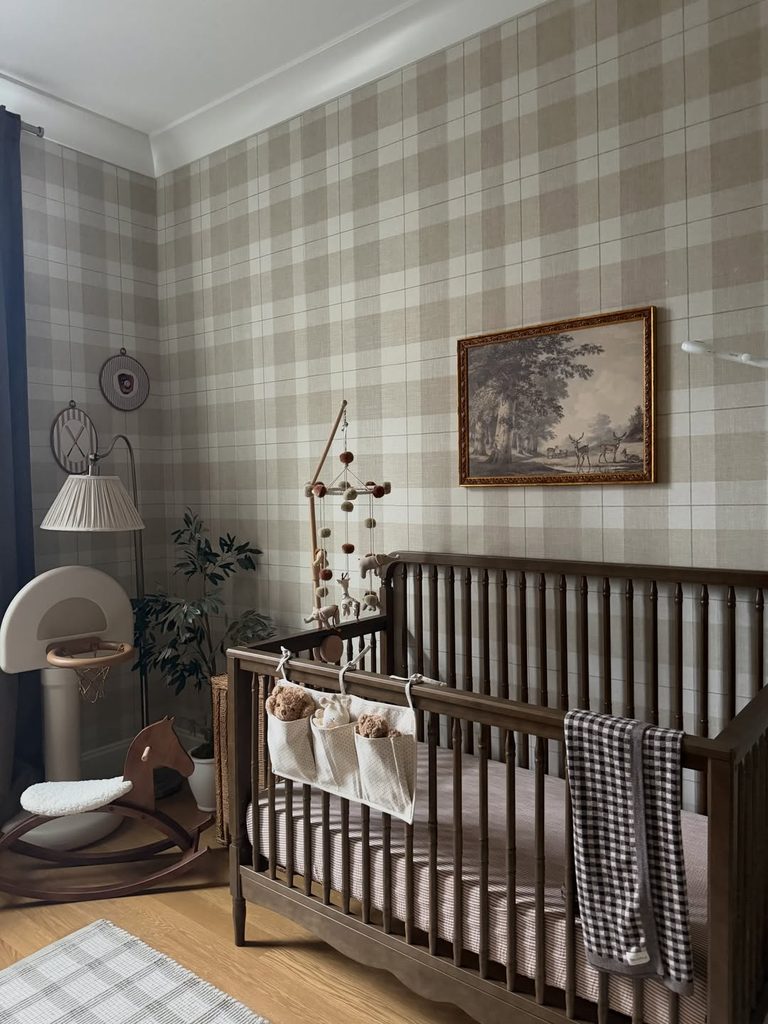
Choose a large plaid with only a small difference between its light and dark bands, so the pattern can cover every wall without becoming the room’s strongest feature. Beige against cream gives you visible checks, but leaves room for the dark wood crib to stand out.
For a cooler version, use pale gray with an off-white ground rather than taking the darker bands all the way to charcoal. That change keeps the grid clear without making every crossing look heavy. I’d keep the checks broad, too; shrinking them would make the walls look busier, especially around furniture with closely spaced rails. Carry the lightest shade from the paper onto the ceiling and trim, so there isn’t another strong line competing with the plaid at the top of the wall.
Two-Tone Walls With Paneling
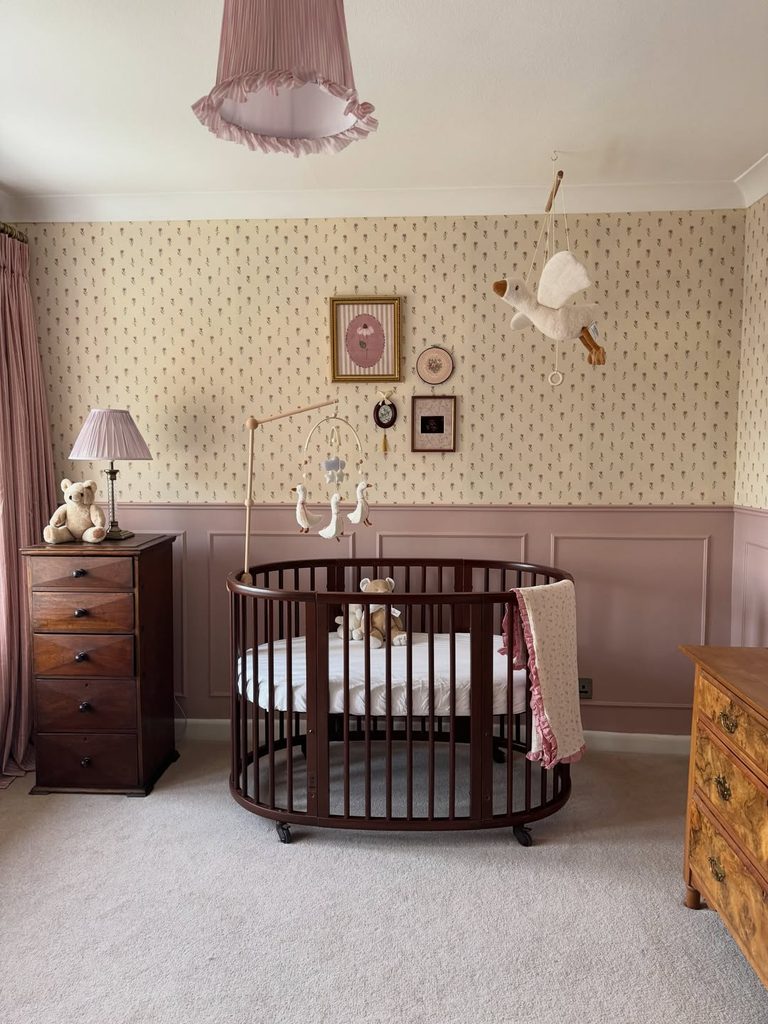
The room is split at about the height of a chair rail. Below it, shallow raised panels are painted a dusty mauve pink, and above it sits a small-scale wallpaper with tiny sprigs on a pale butter-yellow ground. Because the pattern is so small, it blurs into a soft texture from across the room, and the paint underneath keeps it from feeling busy.
If you don’t want to build the panels from scratch, you can glue thin picture-frame molding straight onto flat walls in rectangles and paint the whole lower section one color. Match the paint to a color in the wallpaper, as it is here, where the pink is pulled from the sprigs. That way the two halves look chosen together.
I’d paint the molding and the wall the same shade. A contrast color on the trim would pull attention away from the wallpaper.
Striped Nursery Walls
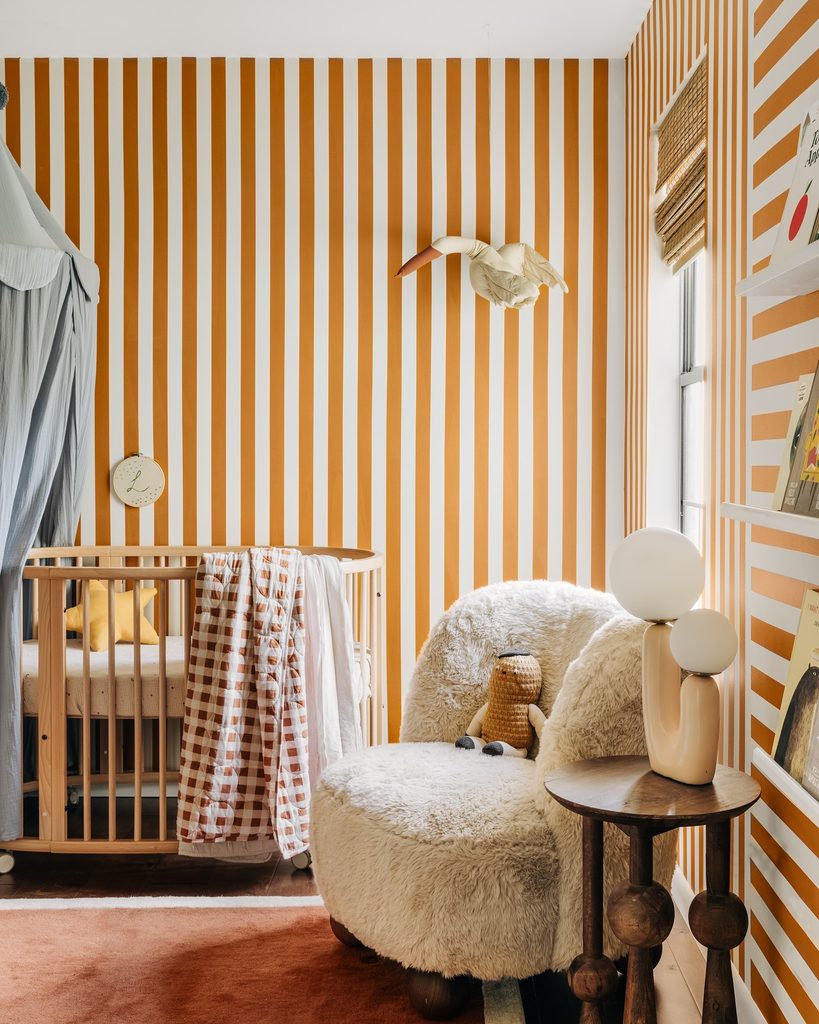
Narrow stripes bring strong rhythm to a nursery, but they can take over when every surface competes for attention. Let the wallpaper carry the pattern and keep larger pieces quiet, as with a plain wood crib and cream chair. Check stripe width against the room: very tight lines can feel busy, while broad bands may crowd a small wall.
Blue Stripes Above Paneling
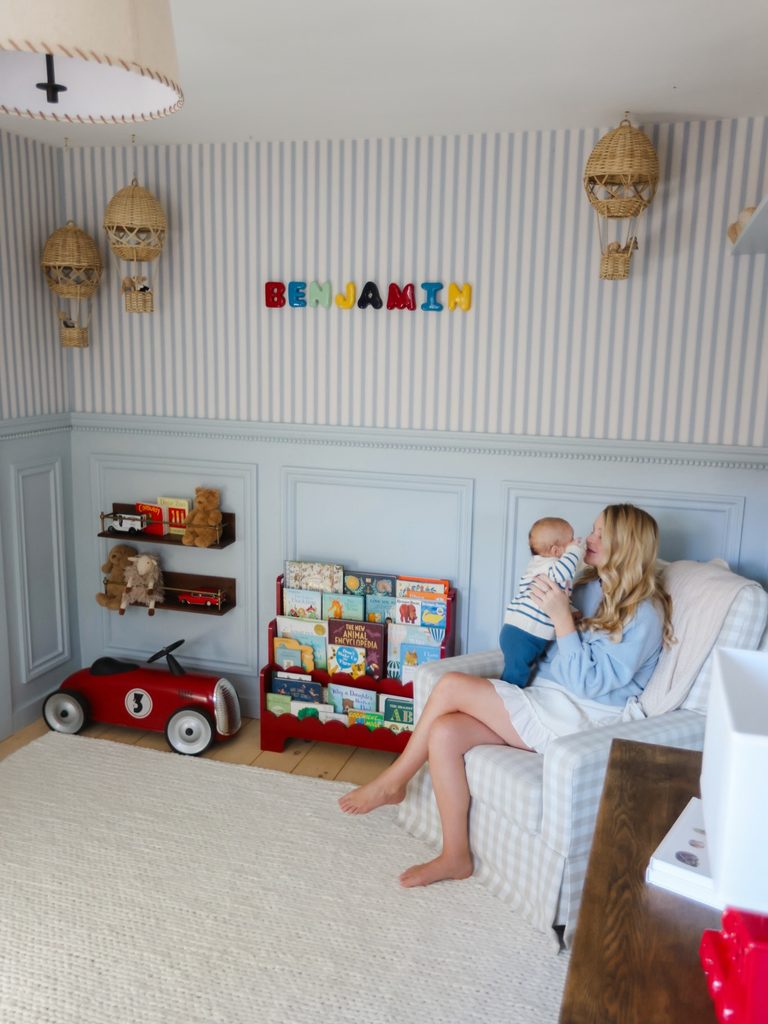
Before choosing wallpaper, settle on the height of the paneling so you know how much striped wall will remain. Paint the lower panels a pale blue, then hang narrow blue and white stripes above. The key is matching the paint to the blue stripe rather than adding another shade; let a red book rack bring in the stronger color.
Wallpaper Above, Paint Below
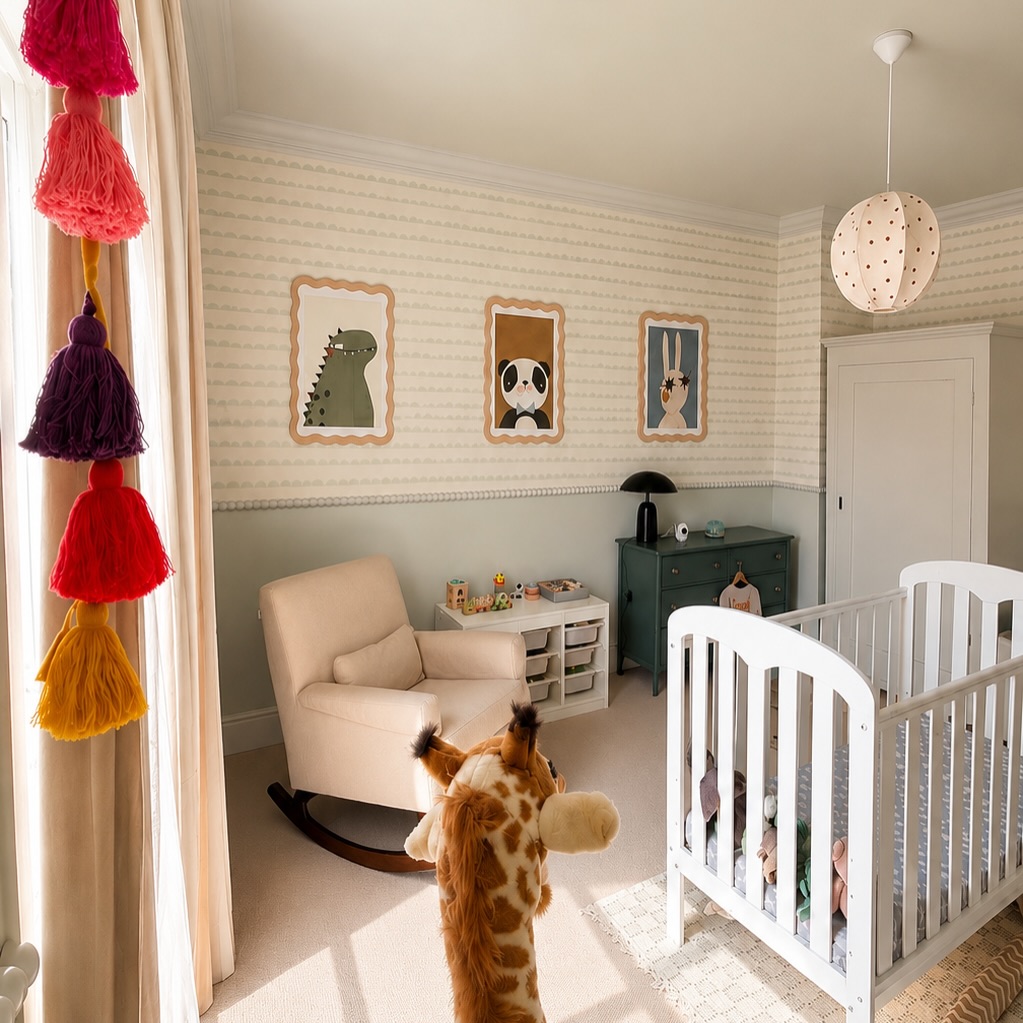
Putting wallpaper on the upper half of the wall and paint on the lower half keeps a pattern from taking over a small room. The scalloped paper is pale cream with soft green arcs, and the paint underneath matches that green, so the two belong together from the start.
What holds it together is the row of small beads along the join. Without it, the paper would stop at a bare line, and any wobble in the cutting or in the wall would show. The beads cover that edge and give the eye a place to stop, so the dresser, the chair and the crib can sit against the painted section without competing with the pattern above.
I’d match the paint to the green in the paper before choosing anything else.
Pink Patterned Wallpaper
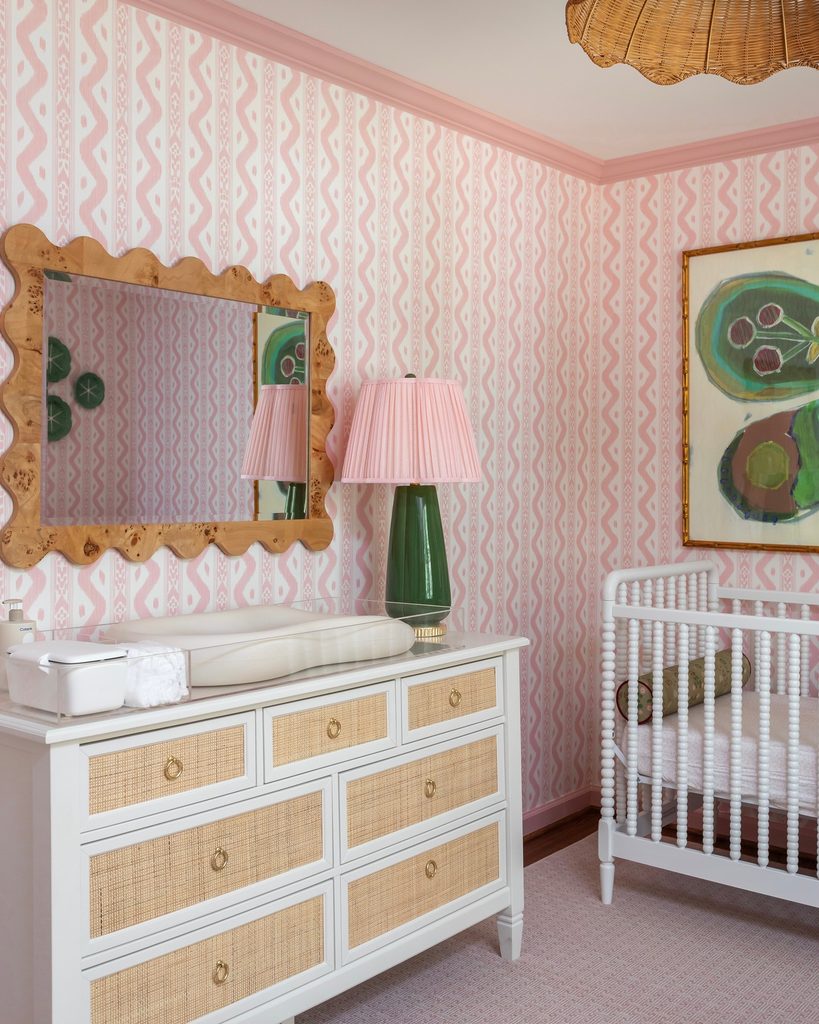
Behind the crib and changing dresser, a small-scale print can cover the walls without competing with the furniture. Pink-and-white motifs carry the color, while cane drawer fronts and a wood-framed mirror break up the repeat. Keep larger art to one wall, where it has room to stand apart.
A Grid of Animal Portraits
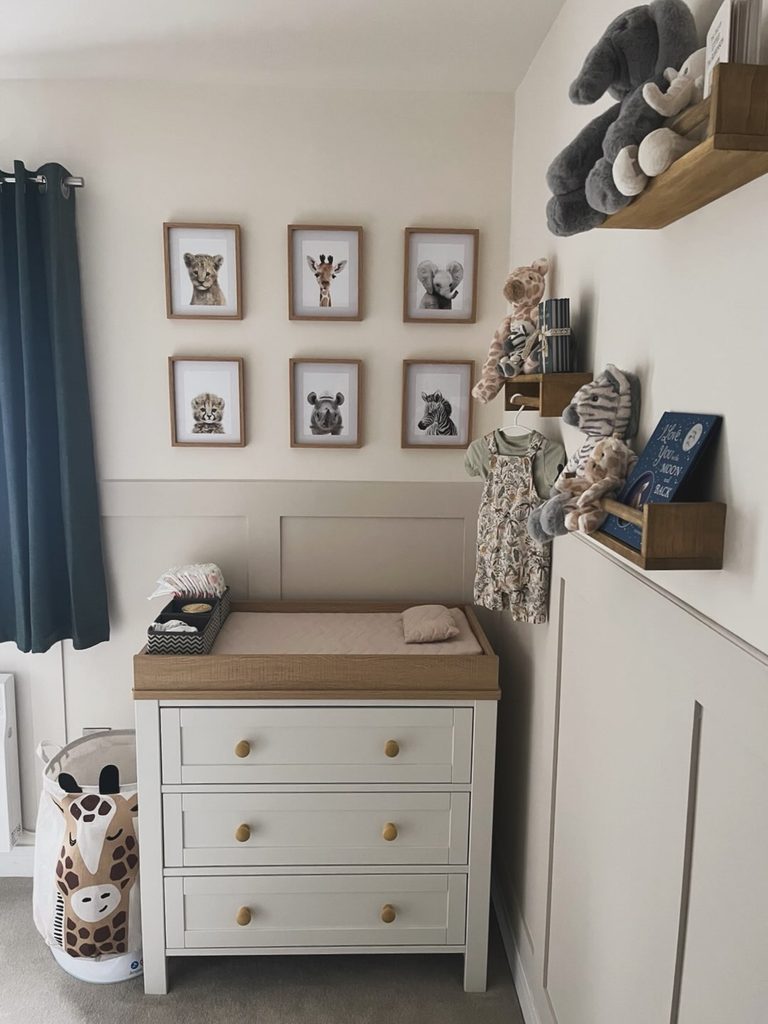
Hang animal portraits in a measured grid rather than scattering them across the wall. Choose prints with the same background and scale, then use matching wood frames so the animals remain the focus. Six pictures arranged in two rows give you room for several favourites without spreading the display across every wall.
Before making holes, mark out the group with paper templates and centre it over the dresser. The step that matters most is checking the gaps: measure between the frame edges, not between the hooks, and keep that distance the same throughout. Start with the middle pair, then work outwards. Leave enough space below the bottom row that the frames sit clear of the changing surface, and secure each one firmly.
A Black Ceiling Overhead
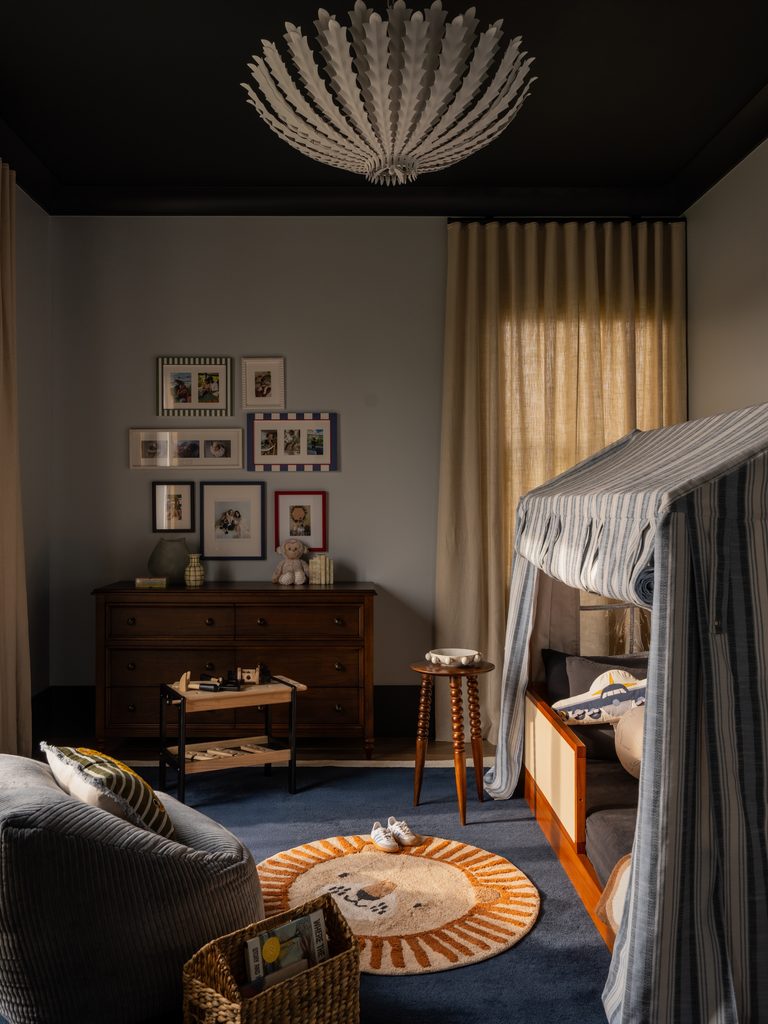
Painting the ceiling a deep charcoal while the walls stay a pale grey gives a nursery a lot of depth without darkening the room at eye level. The walls are a soft putty color, and the dark paint stops at the crown molding, so the contrast sits in one clean line. A flat or matte finish is the right call on a ceiling like this, since gloss would show every roller mark and bounce the light around in odd ways.
The white light fixture is what keeps the dark ceiling from feeling heavy. It’s built from layered petal shapes that look like paper or thin painted wood, and against the black it stands out sharply. If you don’t want to buy a fixture like that, a plain white drum shade or a basic flush mount does a similar job, as long as it’s lighter than the ceiling.
I’d test the paint on a small patch first and look at it at night. Dark colors change a lot once the daylight is gone, and a nursery gets used in the evening more than most rooms.
A Bedside Canopy
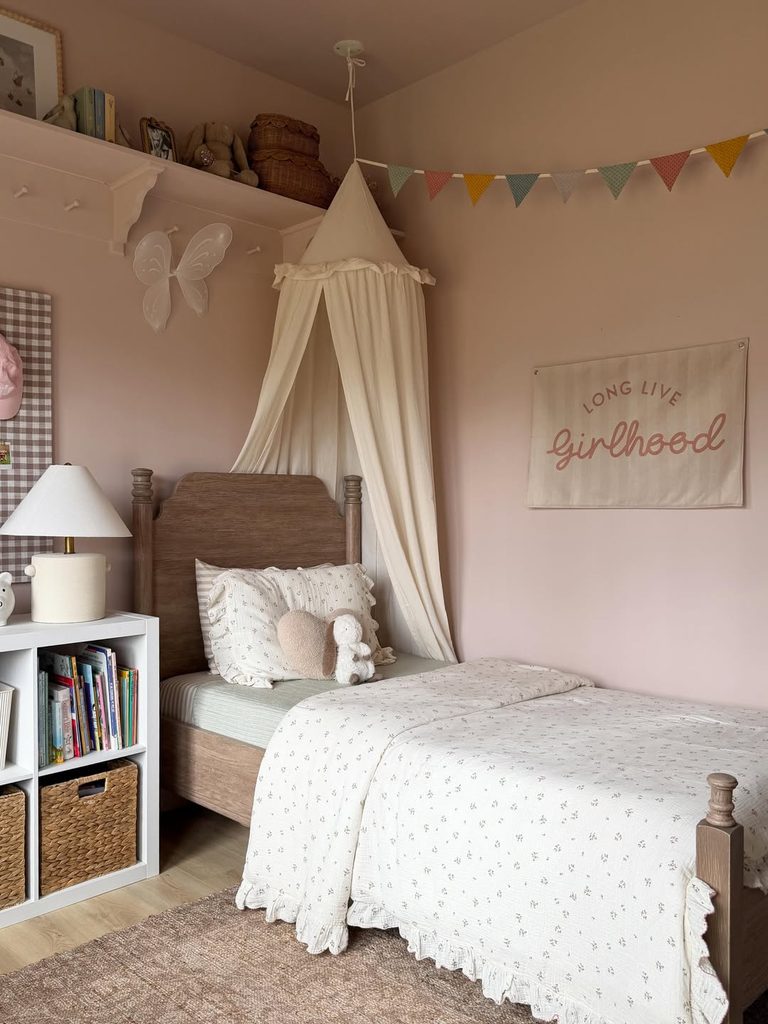
Gathered fabric above the headboard gives the bed a clear frame, then falls beside the mattress. The pointed top draws the eye upward, while the long panels frame the bed without taking up floor space. Choose a light cloth and leave enough room for the panels to hang clear of the bedding; a narrow bed can lose useful space if heavy fabric spills across it. Without the canopy, the carved wooden headboard and small-print bedding would still give the bed detail, but the wall above it would feel more open and the bed less defined.
Keep the rest of the wall spare so the hanging fabric remains the main feature.
A Balloon Print Between Windows
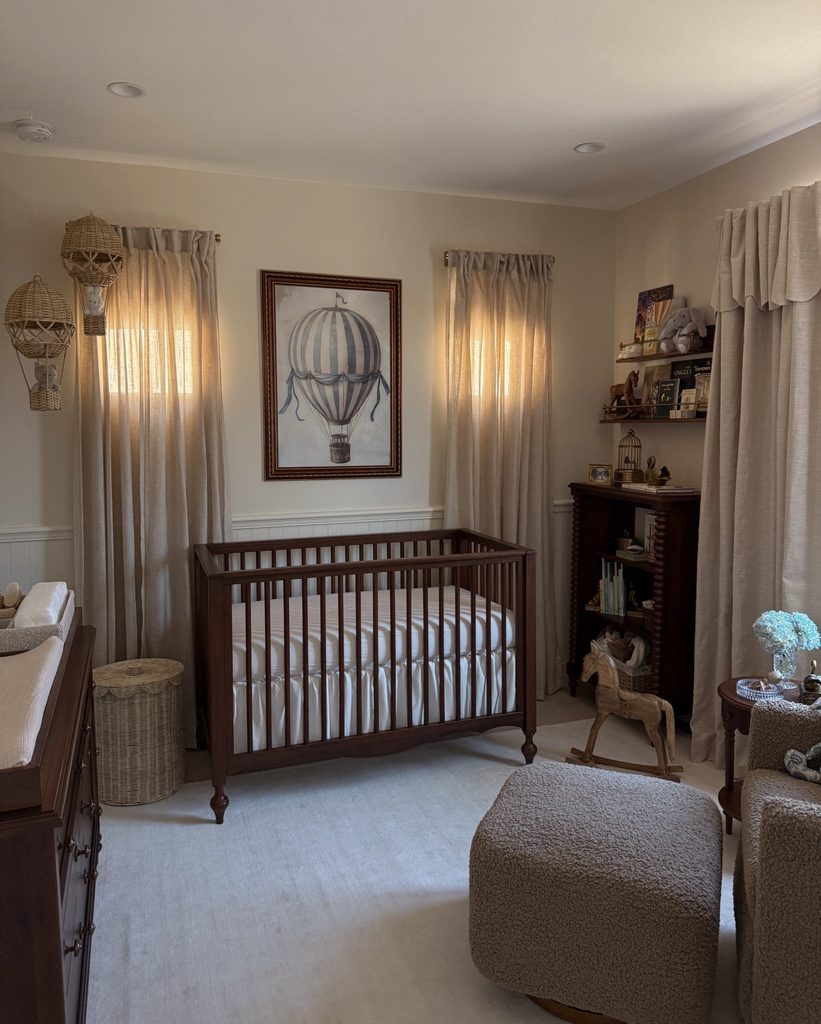
Between two windows, give a balloon print enough wall space to stand on its own. A large framed drawing works above the crib, where a group of smaller pictures could get lost between the curtains. Choose a print with a pale background so the frame defines its edge without adding another block of color.
On a wall like this, center the artwork over the crib rather than against the full width of the room. The dark frame can echo the wood below. Leave the nearby wall clear so the balloon’s shape remains the focus.
A Gallery Wall Above the Crib
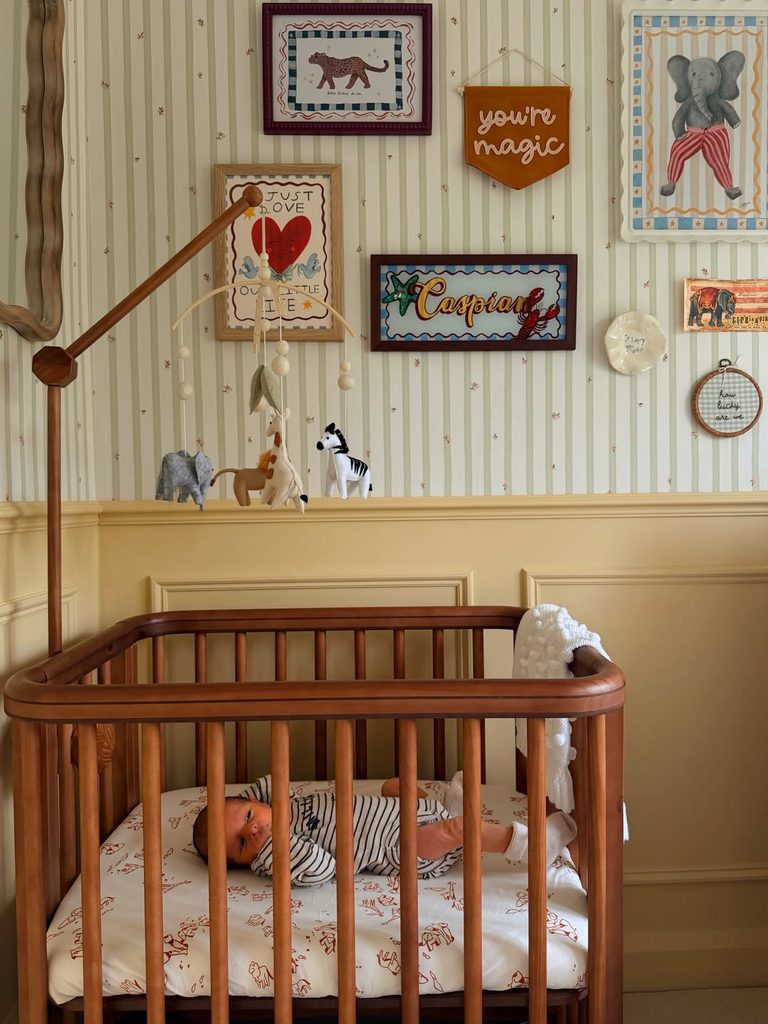
Art over a crib works best when the pieces stay light and sit well back from the mattress. Here the frames are small, mostly under a foot wide, and they hang on the wall above the paneling instead of down near the rails. That height matters, because anything heavy hung low becomes a problem the day the baby can stand and reach.
The other common mistake is letting every frame fight for attention. A shared set of colors holds this group together: red, navy, and mustard repeat across the prints, the felt banner, and the small embroidery hoop. With stripes behind them, I’d keep the frames to a few finishes, as these do.
A Fine Floral Wall
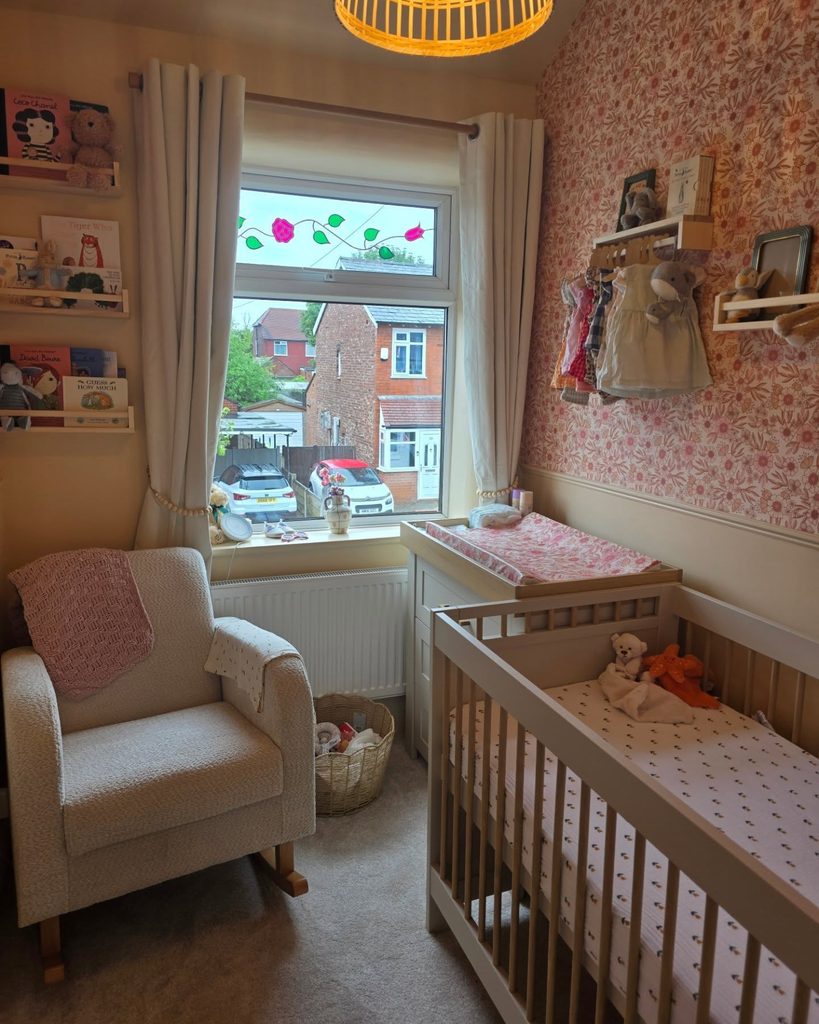
A fine floral print brings pattern into a nursery without covering every surface. Scale matters: tiny flowers leave more open ground between motifs, while larger blooms make a wall feel busier from across the room. Keep the paper to one wall and let the surrounding paint, curtains, and cot stay close to ivory or pale wood. The contrast gives the pattern a clear edge and leaves space for shelves and clothes in front of it.
Color shifts the effect too. A dusty pink ground with muted red and green flowers feels quieter than a white background with bright colors. I’d choose a low-contrast print if the wall also carries storage; the flowers stay visible without competing with everything hung nearby.
Pink Ruffles With Plain Wood
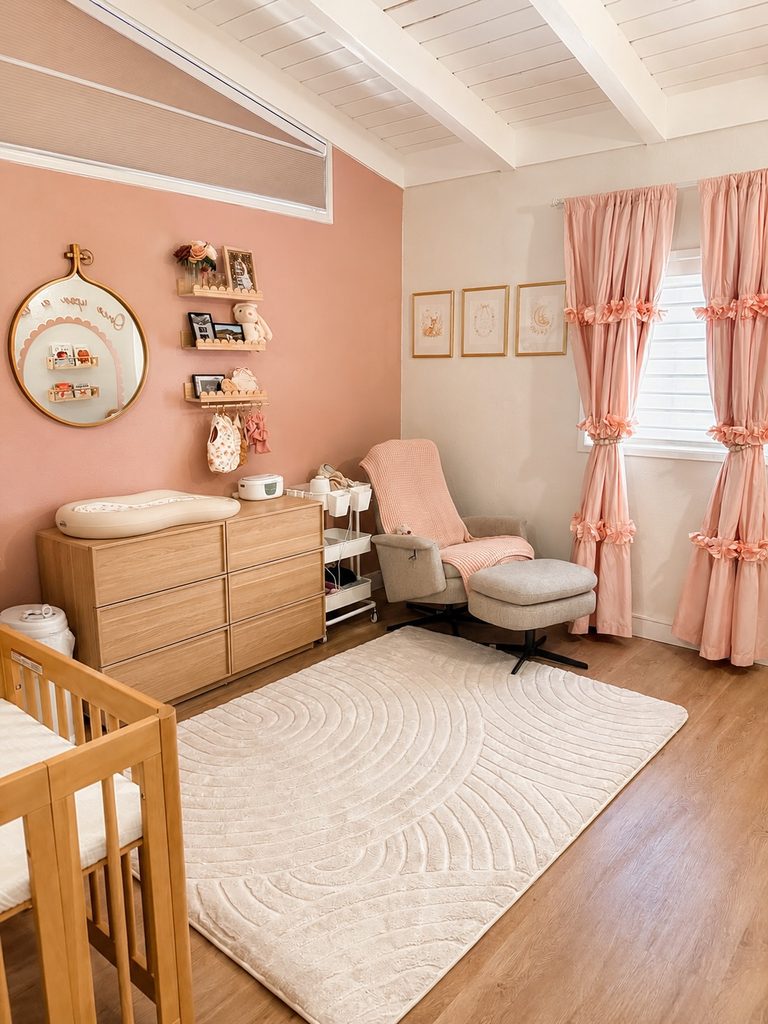
For a nursery with plenty of pink but little pattern, let ruffled curtains carry the decoration. This is a good choice if you like traditional details but don’t want floral prints across the walls, bedding, and floor. The gathered bands give the fabric enough shape that you can leave those other surfaces plain.
If you and your partner differ on how much frill to use, the pale wood dresser offers a useful counterweight. Its flat drawer fronts give the eye somewhere to rest without introducing another decorative theme. I’d take this route if you want the fabric to be the part you change as your child grows. If you prefer crisp folds or want curtains that are easier to iron, choose a room with plain panels instead; the ruffles are a detail you need to enjoy.
Sage Paneling With Natural Wood
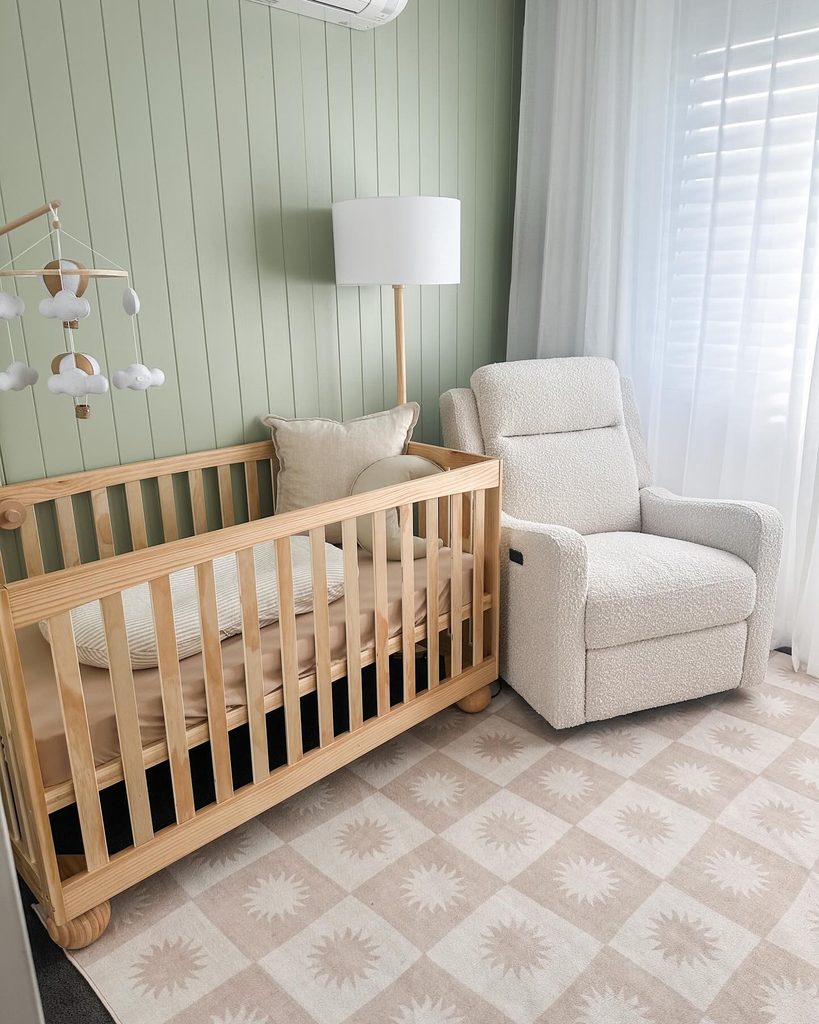
Vertical tongue-and-groove boards painted a soft sage green give the wall its texture without any pattern. The paint sits flat against the grooves, so the lines show up as shadow instead of color. If you don’t have paneling, a flat wall in the same green works fine, and thin wood battens glued up in even rows get you most of the way to the same look.
The wood in the room is all one tone. The crib is a pale natural timber with rounded feet, and the lamp base matches it. A light stain on any pine furniture would land in the same range.
Softness comes from the fabrics. The recliner is covered in a nubby cream bouclé, and the rug is a beige check with sun shapes in it. A plain wool or cotton chair in off-white would work, and a flat-weave rug in sand or oatmeal does the same job as the printed one.
A Gingham Canopy
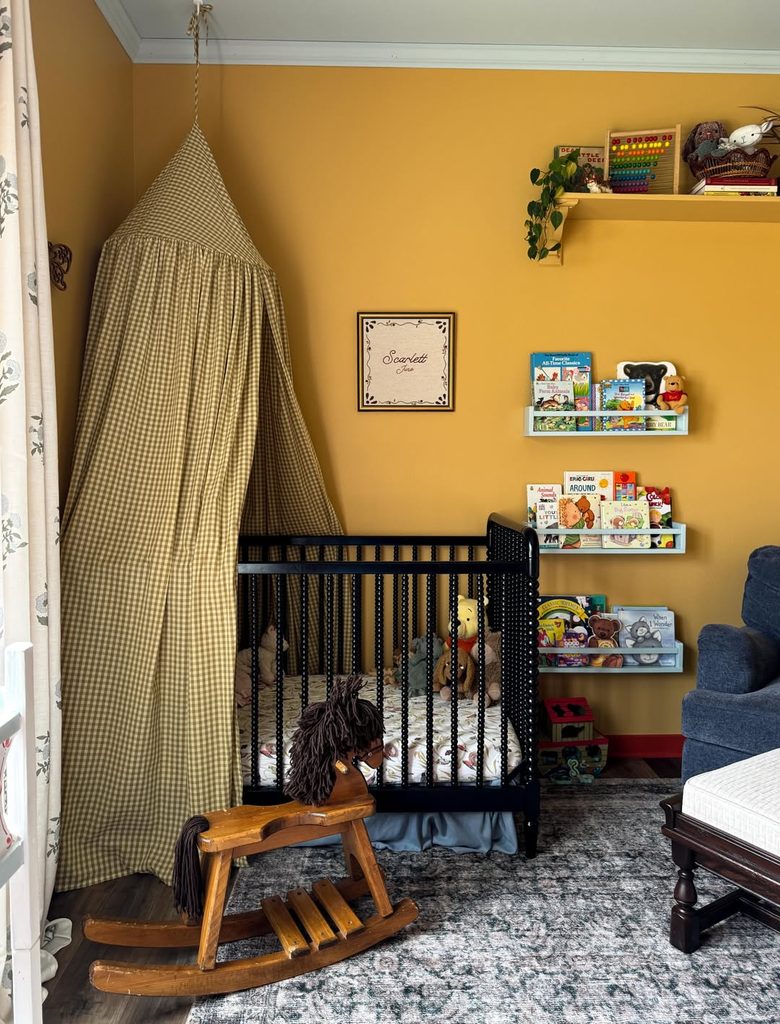
From a ceiling hook, gingham fabric can fall beside a crib and soften a tall wall without taking up floor space. The trouble starts when the cloth hangs over the mattress or within a child’s reach: it can be pulled into the crib, and the long folds collect dust. I’d keep the canopy entirely outside the sleep space, anchor its hook securely, and check that no panel can reach the rails as the child grows. A narrow drape still frames the crib without becoming loose bedding.
Woven Texture Above and Below
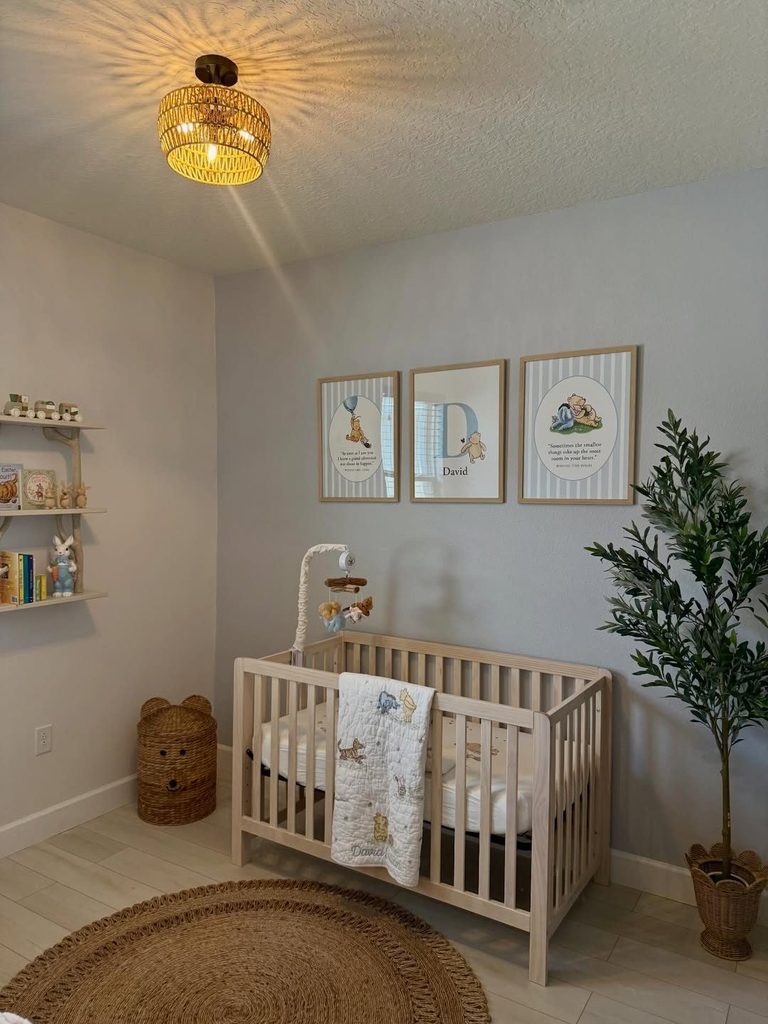
Bring woven texture into a nursery at ceiling and floor level, especially when there is little room for extra furniture. A basket shade over the main light adds texture without taking up wall space, while a round woven rug can sit just in front of the crib.
Leave some bare floor around the rug so its edge stays distinct from the furniture. In a room with pale wood, these darker straw tones give the crib area some contrast without adding another color to the walls.
Painted Lower Walls Under Wallpaper
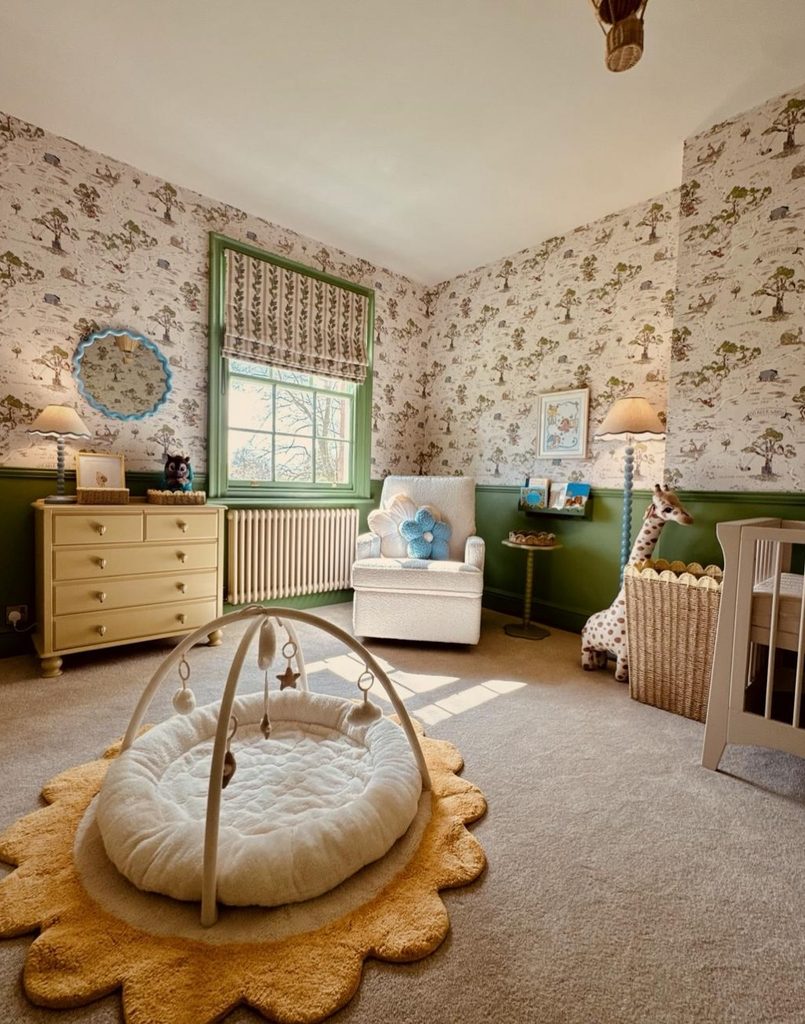
Start with the wallpaper and let it decide the paint. A busy print like this woodland scene already contains the greens you need, so pick one from the leaves and match the lower wall to it. Take a paint sample outside, hold it against the paper in daylight, and judge it there, because the shade will look different under a bedroom bulb.
Once the color is settled, mark the height of the line. Here it sits about level with the arms of the armchair, which keeps the pattern above furniture and leaves the paint to take the knocks from cots and baskets. Use a level and a pencil, and run the line all the way around before you cut or paint anything.
Hang the paper first, trimming it to the line, then paint the lower wall up to it. Carry the same green onto the window frame so the two halves connect. I’d use a washable finish on the lower section, since that’s the part that gets scuffed.
Yellow Walls, Collected Art
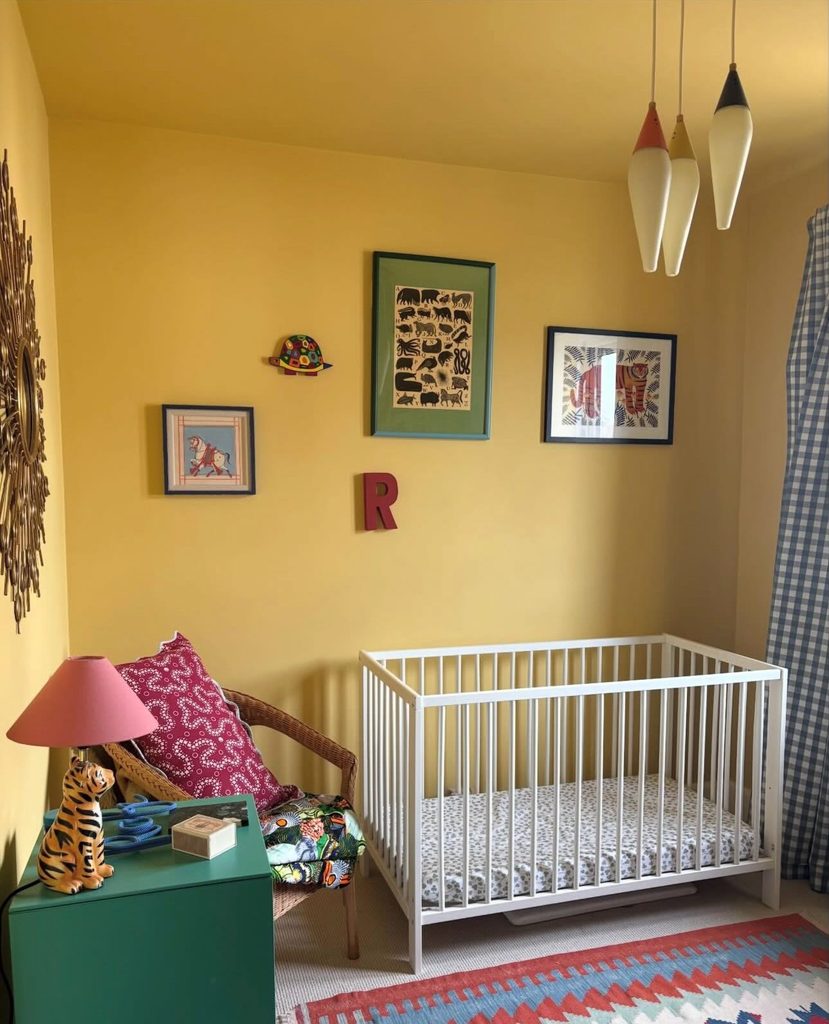
Yellow walls and a mix of framed prints give this nursery a lively look without relying on a theme. It works for parents who want the room to feel personal and plan to add pieces over time, rather than match every detail. Anyone who prefers muted colors or a pared-back backdrop may be happier with a quieter palette and fewer objects on display.
Dark Wood Against Cream
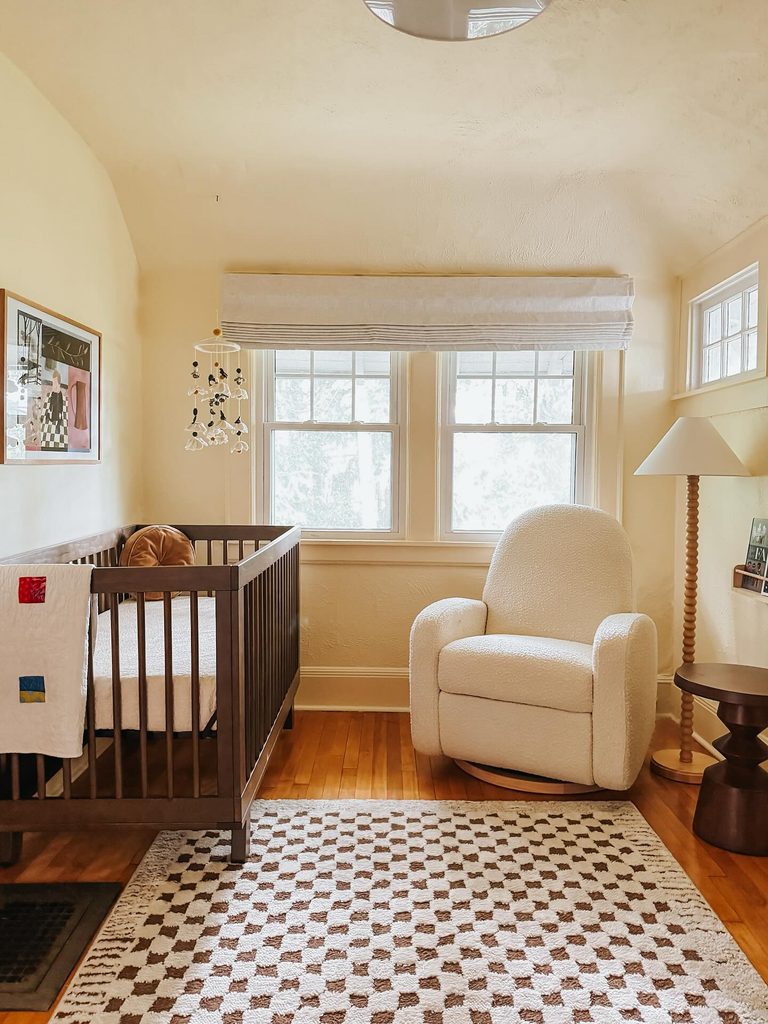
Against cream walls, a dark wood crib gives the nursery a clear outline without adding another color. Its slatted sides stand apart from the pale upholstered chair, while the brown checks in the rug repeat the wood’s depth near the floor.
For a lighter version, choose the same crib shape in pale oak and leave the cream fabrics in place. The contrast will soften, and the grain will become more noticeable than the frame, especially beside a chair with a rounded back. Carry that lighter wood through to the side table rather than adding a second dark finish. I’d leave the rug brown and cream so there is still some contrast beneath the furniture, even when the larger wood pieces are pale.
Two-Tone Walls With Stars
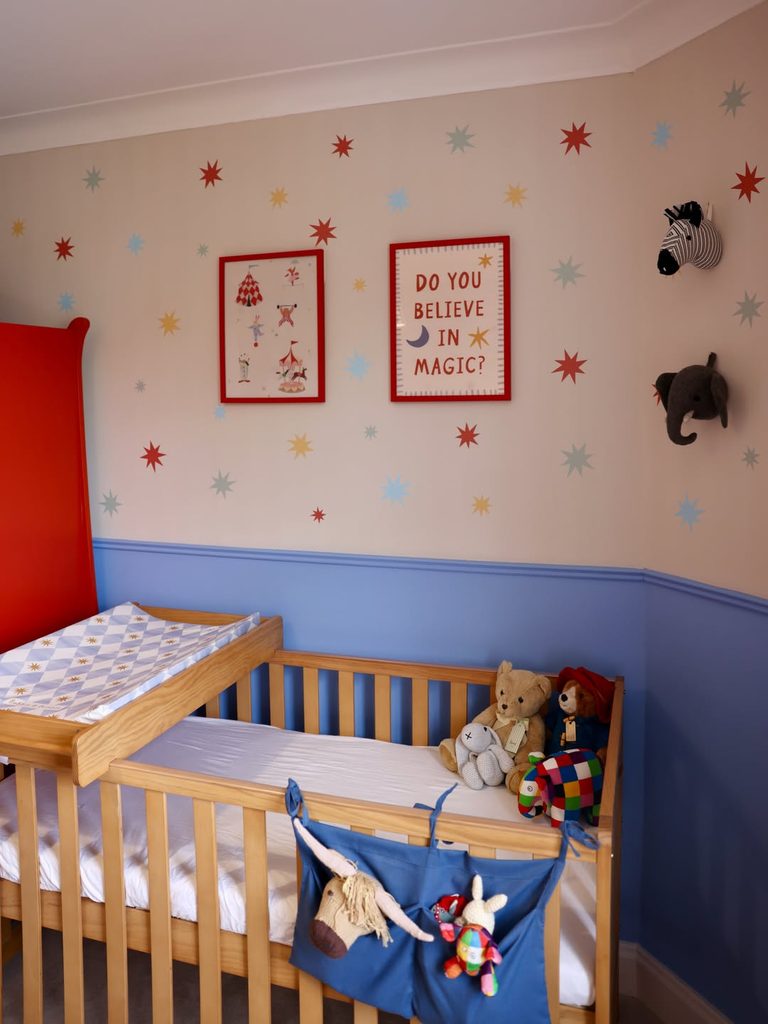
A painted band of blue runs about a third of the way up the wall, with a thin ledge of trim marking where it stops. Above it, the pale pink-beige is covered in small stars in red, mustard and light blue, scattered at different sizes and angles. The band is what keeps the stars from taking over. Without it, the whole wall would be spotted from floor to ceiling, and the cot would disappear into the pattern.
The blue also gives the pine cot something solid to sit against. I’d keep the stars to the upper section only, and I’d space them unevenly, as they are here.
A Dresser Changing Station
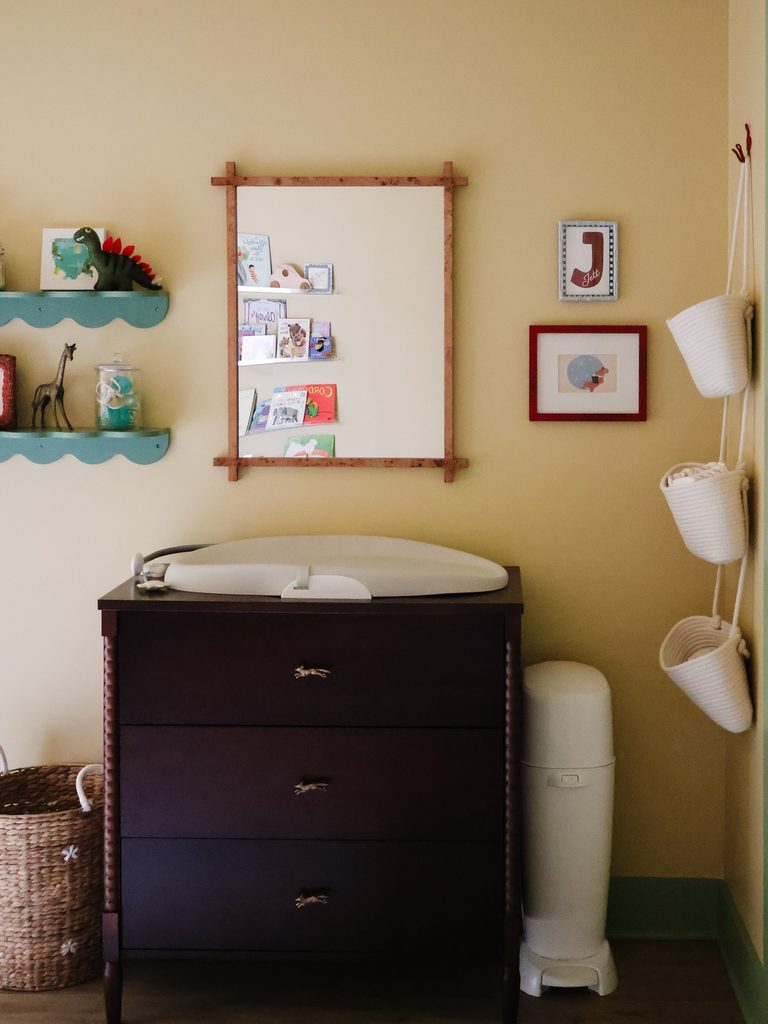
At the end of a nursery wall, a dresser can hold a changing pad without giving up the storage below. Leave enough room for the drawers to open and to stand close to the pad; placing the dresser against a wall also keeps the center of the floor clear. A deep dresser gives the station a steady base, while a wall rack above can hold a few books within an adult’s reach.
Put the most-used clothes, diapers, and wipes in the top drawers so you can reach them during a change. A diaper pail can sit beside the dresser if there is room, but leave a clear path and make sure its lid is easy to reach. This arrangement is useful in a small nursery where one piece of furniture needs to handle more than one task. When the changing pad is no longer needed, the dresser can stay in place for everyday storage.
Red Trim With Pale Blue
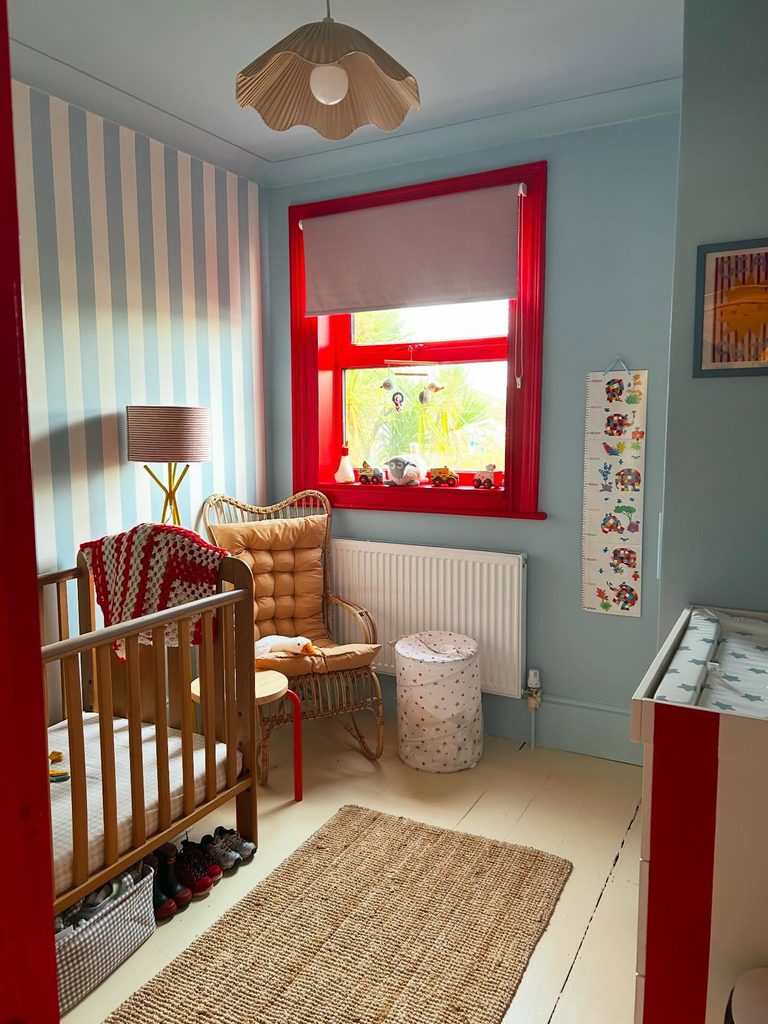
Paint the window frame red against pale blue walls, then carry that blue into stripes on one wall. Choose the wall colour first and test the red beside it before painting the woodwork. A blue with some grey in it will give the red less competition than a brighter shade.
For the stripes, paint the wall in the lighter colour first, then measure and tape equal widths once the base is dry. The step that matters most is sealing the tape edges with the base colour before adding blue; this helps stop paint bleeding under the tape. Leave the other walls plain so the stripes stay distinct. Finish with wood furniture and a woven rug rather than adding more large areas of red.
Patterned Walls Above Dark Wainscoting
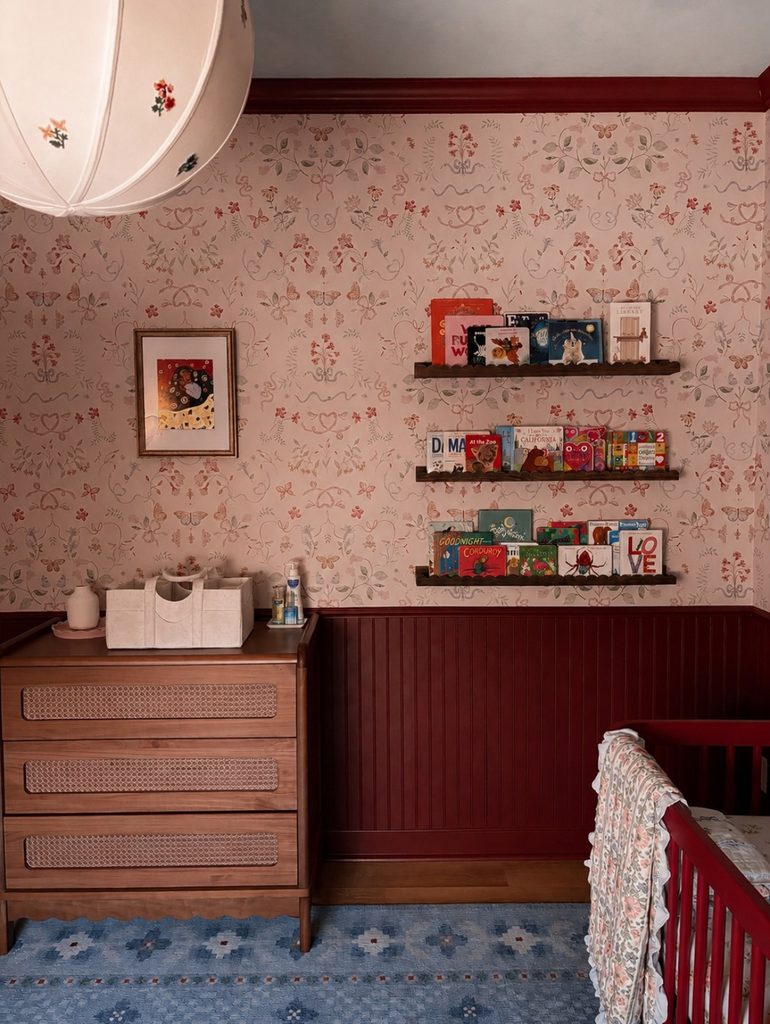
A small-scale floral wallpaper can turn busy fast when it runs floor to ceiling in a nursery. Here it stops at a deep red paneled lower half, which gives the eye a plain surface to rest on. Keep the paneling’s color close to one of the reds in the print, or the two will fight.
Hang the picture ledges directly over the pattern, but fill them with books so the covers carry the color and the wallpaper stays in the background. One framed print on the open wall is enough. A second would crowd it.
Dresser Changing Station
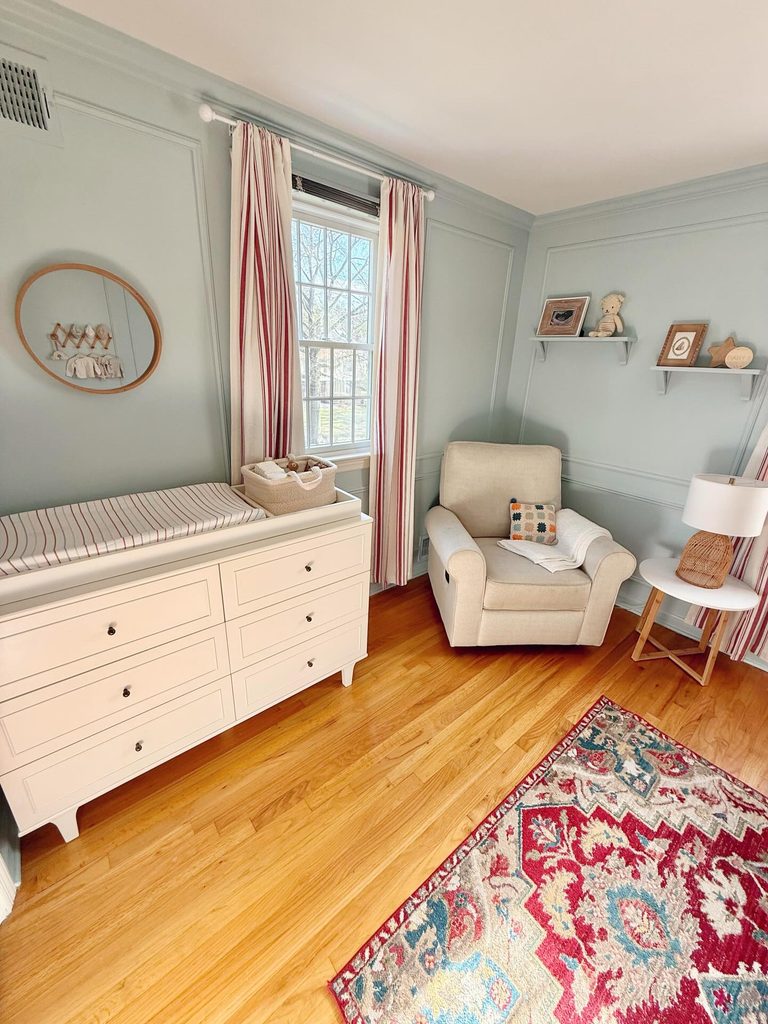
A painted wood dresser gives the changing area a broad surface and keeps clothes within reach. Add a fitted changing pad with a washable cover, then use the drawers for diapers and spare sheets. With a narrow dresser, add a secure changing top instead of another table.
A Dresser for Changing
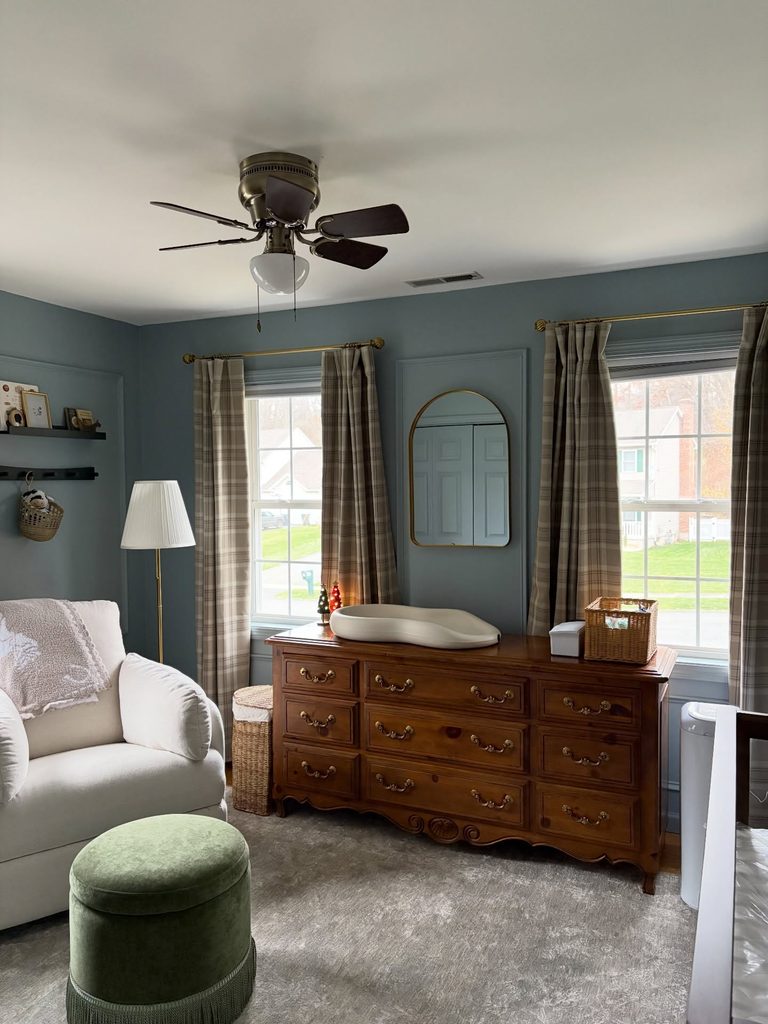
If you want nursery furniture you can use after the diaper years, make a wood dresser your changing station. A contoured changing pad sits on top, while the drawers hold clothes and spare bedding. This is a good route for parents who would rather choose one substantial piece than buy a changing table with a short working life.
For anyone who likes older furniture, a dresser with carved drawer fronts gives you something to build the room around without needing a matching set. It also lets you put more of the budget toward a piece you expect to keep. You do need enough floor space to open the drawers fully and stand in front without blocking the path to the crib.
In a small nursery, a narrower changing unit may be the better choice. And an existing dresser needs more than a pad laid on top: anchor it to the wall, check that its height is comfortable, and use a changing pad approved for that surface and secured as directed.
Blue Windowpane Check Walls
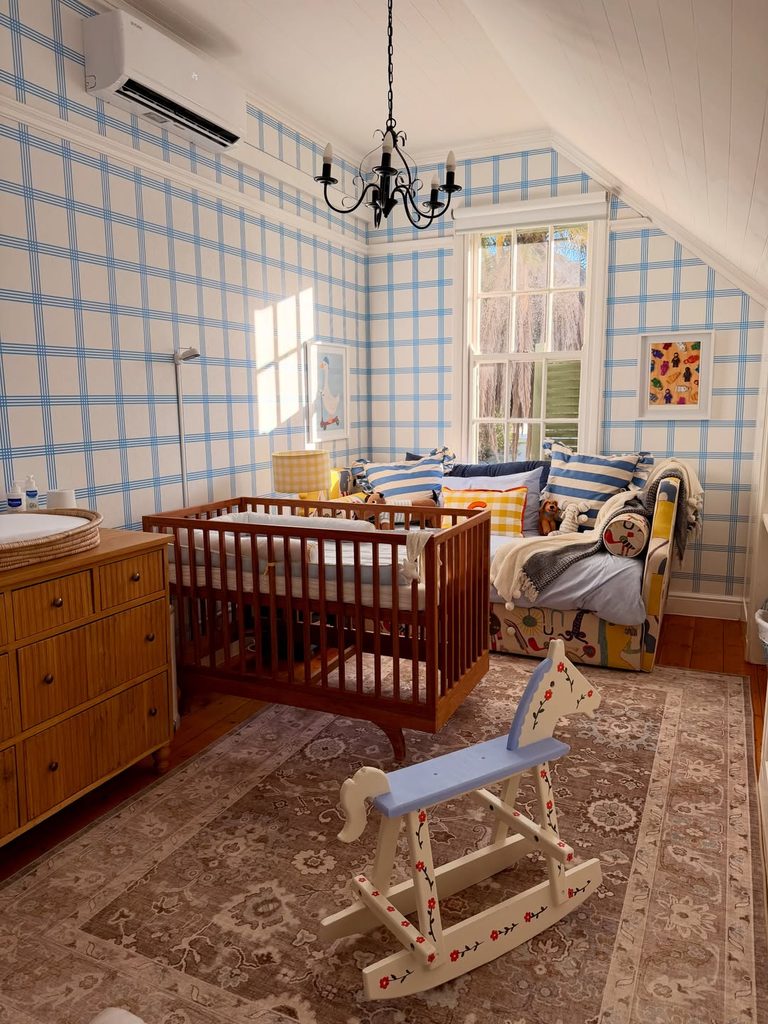
A hand-painted windowpane check in pale blue on cream covers every wall here, right up the slope of the attic ceiling. The lines are different widths and spaced unevenly, which keeps the pattern loose enough to live with in a small room.
The variation worth thinking about is line weight. Thin, tight lines would read as a fine plaid and get busy fast, especially with the striped pillows and the printed daybed on the same wall. Wide, open squares like these leave plenty of cream showing, so the crib, the rug and the painted rocking horse still get looked at. I’d keep the blue to one shade, as it is here, and let the furniture bring in the wood and yellow.
Books at Child Height
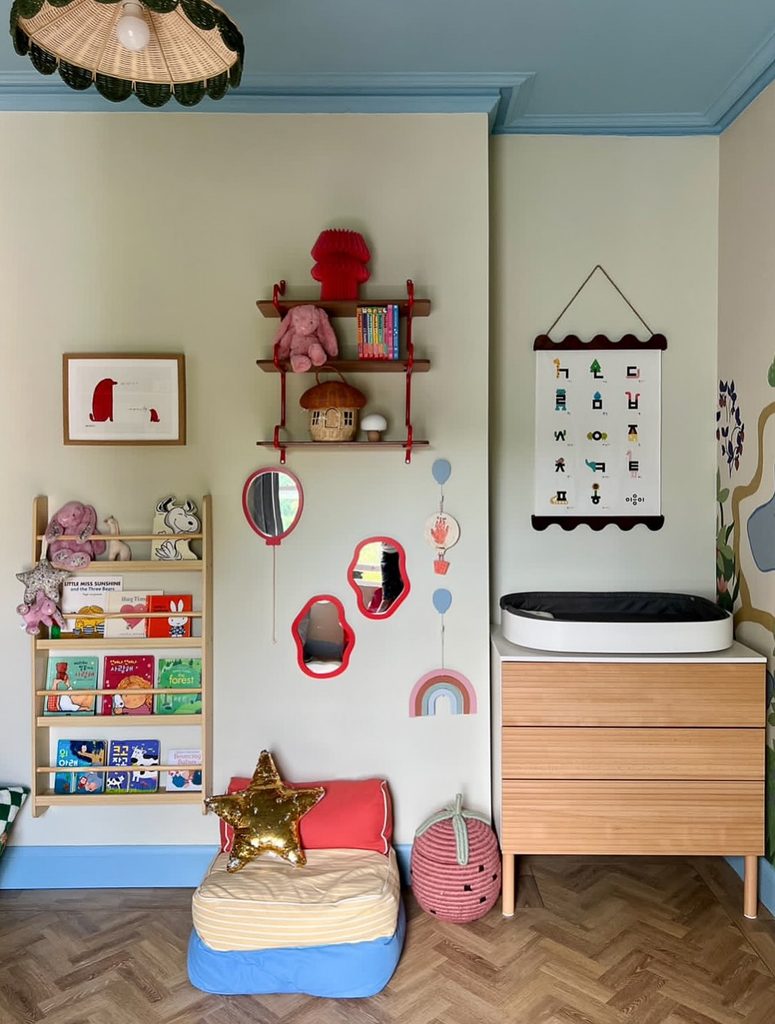
A front-facing book rack turns a narrow strip of wall into useful storage. Its shallow shelves let children choose books by cover and keep them easy to put back. Without the rack, the books would be tucked into a cabinet or stacked on the floor, and the wall would lose one of its clearest signs that this room is made for a child.
Low Contrast Leaf Wallpaper
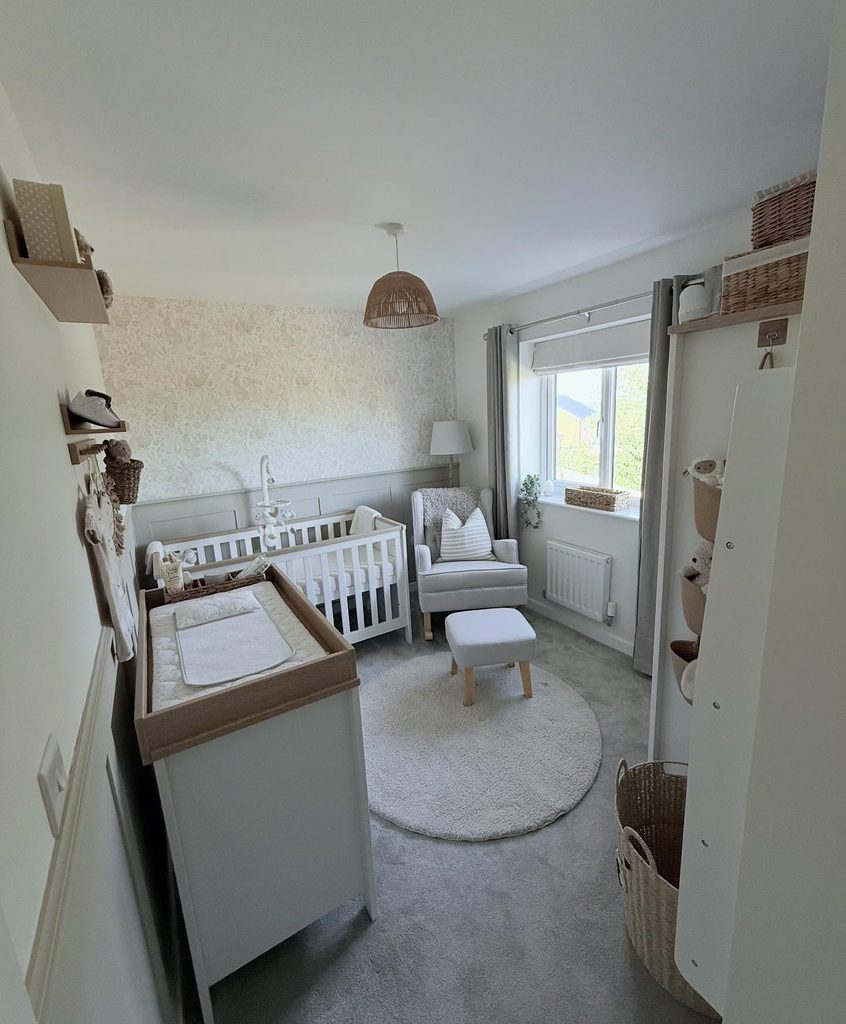
Above gray wall panels, choose a leaf print only a shade darker than its cream background. The pattern gives the upper wall detail without drawing a hard line around every leaf. That matters in a narrow nursery, where the cot sits close to the paper.
For a variation, use the same small print in pale green rather than beige, with the background left cream. The green will make the leaves more distinct, but a muted shade will still sit easily beside white furniture and gray paint. I’d keep the pattern small; larger leaves would pull more attention toward the wall and away from the cot and chair beneath it.
Natural Materials Throughout
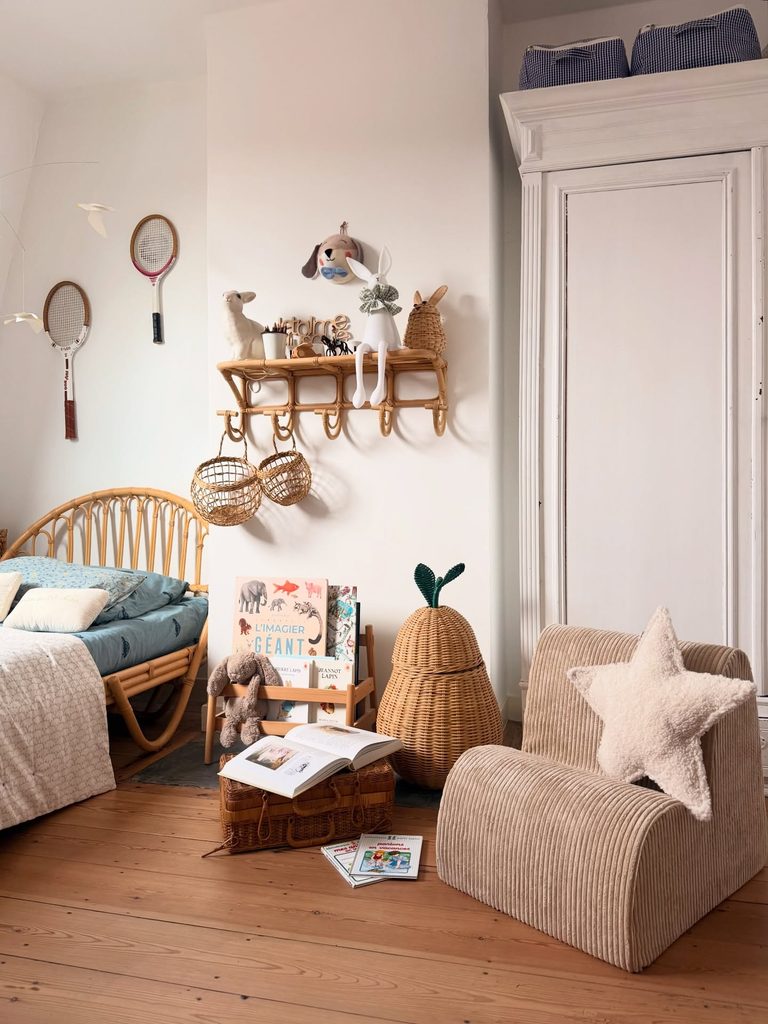
A room built from rattan, wicker, corduroy and bare pine boards can go flat when every piece is the same honey brown. Here the wall and wardrobe are white, which gives the wood something to stand against, and the blue bedding and checked bags on top of the wardrobe add a second color so the baskets don’t blend into the floor.
The other risk is clutter. Wicker storage invites you to keep adding, and a pear basket, a hamper, a wall rack and two hanging baskets can crowd a corner fast. I’d hold to one large basket on the floor and one shelf at eye level for the small things. Leave the wall above the bed mostly bare, with just two vintage rackets and nothing else.
A Soft Crib Canopy
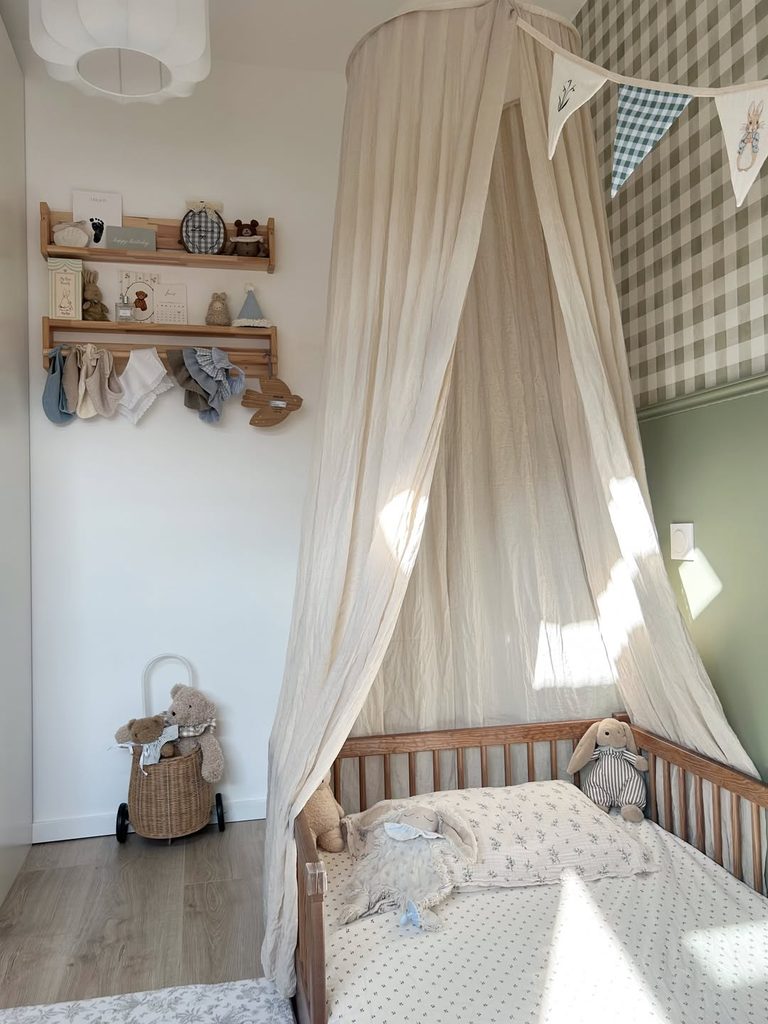
From a round hoop, light cotton voile or gauze falls in long folds around a crib, giving it a defined frame without another solid piece of furniture. Linen works too, though its heavier weave may need stronger support. A length of muslin threaded through an embroidery hoop makes a similar canopy if you cannot find one ready-made. Hem the edges to prevent fraying, and choose fabric that can be washed.
Fix the hoop to a ceiling joist or use an anchor made for the ceiling material. The fabric must stay well out of the baby’s reach and clear of the crib, rather than draping over the sleep space. A plain cream fabric pairs easily with patterned walls and bedding. If the ceiling mount is impractical, a wall-mounted arm can hold the hoop above the crib, provided the fabric still hangs beyond reach.
Tonal Pink Wall Paneling
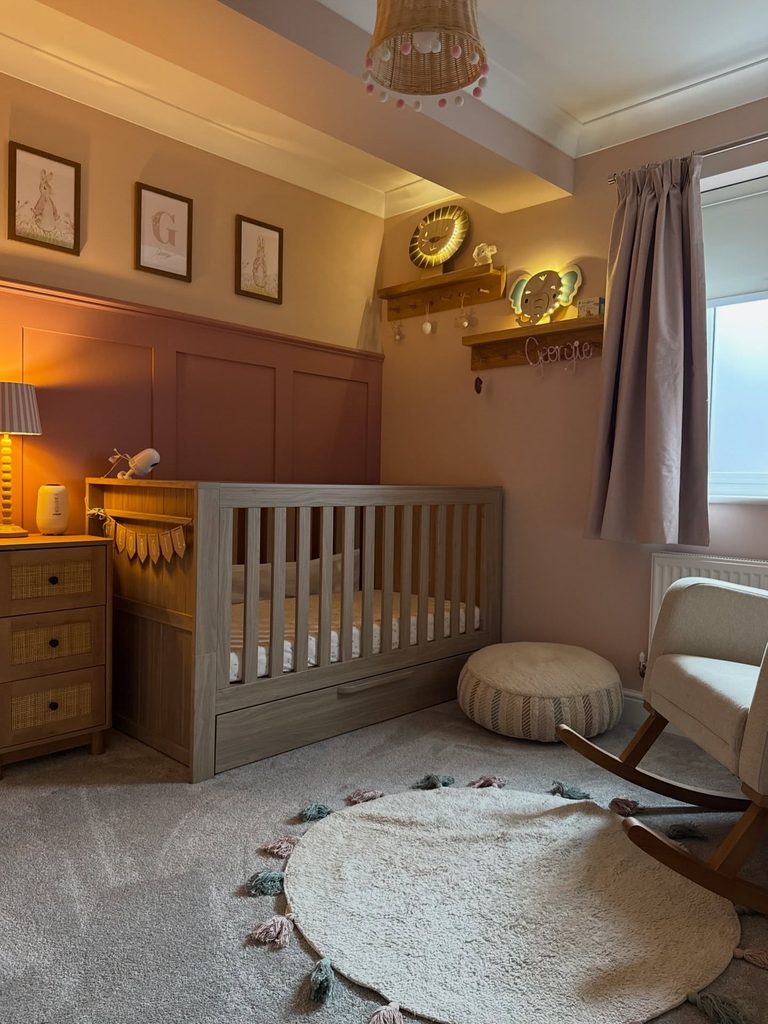
Run dusty rose paneling behind the cot, then use a lighter shade from the same color family above it. The change in depth gives the wall some structure without adding another pattern.
Choose the panel height first, marking it with tape so you can judge it against the cot and any nearby furniture. Then plan the spacing of the upright strips, keeping the gaps even rather than squeezing a narrow panel into one corner. Fit the trim, fill the joints, and prime before painting.
Test both wall colors together before buying the full amount. This is the step that matters most: a pink with a gray undertone can look muddy beside one that leans peach. Check large samples in daylight and under the lamp you will use at night. Once the shades work together, bring in pale wood furniture and plain bedding so the wall remains the main source of color.
A Storybook Nursery
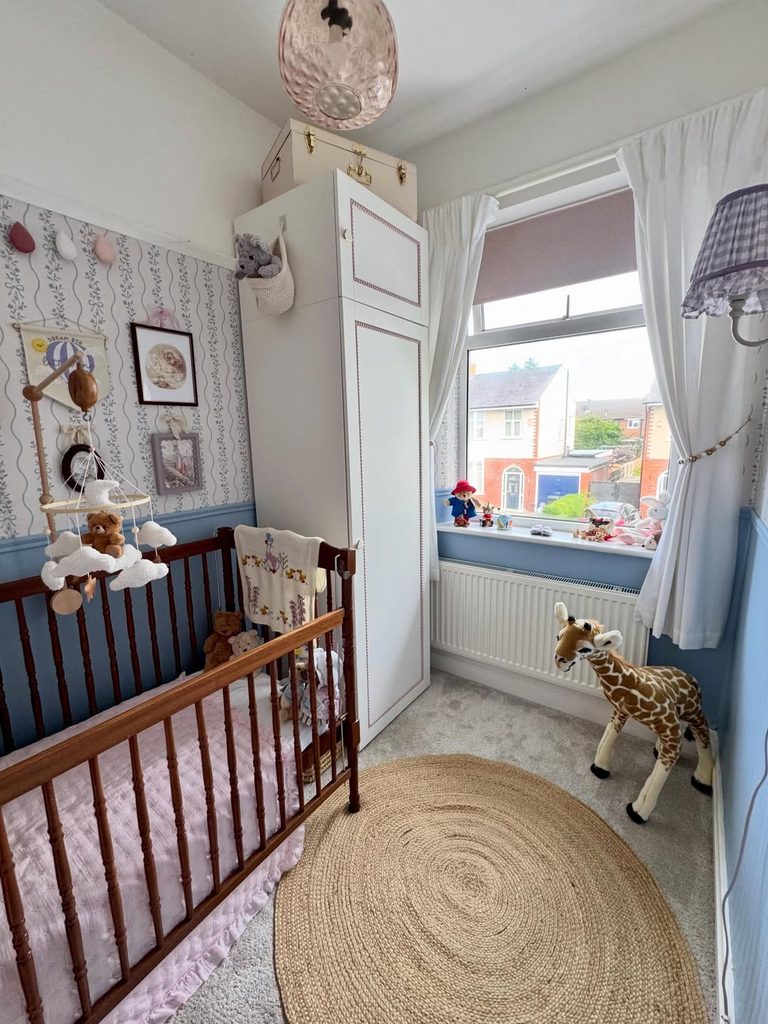
A nursery can be built from things that look like they belonged to a grandparent: a dark wood cot with turned spindles, a small framed print on the wall, a bear in a red hat on the windowsill. The wallpaper has a thin grey-green vine stripe, and it stops halfway down where the wall is painted blue. That split keeps the pattern from taking over a room this narrow.
This is right for anyone who already likes old-fashioned things and has a few to hand, whether that’s a hand-me-down cot, an embroidered blanket or a shelf of well-kept toys. It works in a box room because the furniture is small and the jute rug is round, so nothing blocks the floor.
If you’d rather have an empty room with clean lines, pick another idea from the list. This look depends on many small objects, and they collect dust and need moving around. Anyone who doesn’t want that job should go plainer.

